


How to Coach Flag Football: The Complete Beginner's Guide
You volunteered. Maybe your kid's team needed a coach, maybe you raised your hand before thinking it through. Either way: first practice is next week and you've never coached a down in your life. Breathe. Thousands of parents do exactly this every season, and the bar is lower than you think.
This guide is your zero-to-first-practice roadmap. It covers what you actually need to know before you step on the field, and just as important, what you can safely ignore until later.
1. What flag football actually is (the 2-minute version)
Flag football is football without tackling. Instead of tackling the ball carrier, defenders pull a flag (or two) off a belt worn around the ball carrier's waist. That ends the play. Everything else you know from watching football on TV mostly applies: the offense gets a set number of downs to advance the ball, a touchdown is 6 points, and the team with more points wins.
Youth games are usually played 5-on-5, 6-on-6, or 7-on-7 (your league will tell you which) on a shorter field (often about 60 yards long) with two 20-minute halves and a running clock. There are no kickoffs in most youth leagues; each possession starts at the offense's own 5-yard line.
Here's the most important thing to understand: at the youth level, flag football is a developmental game, not a competitive one. USA Football, the sport's national governing body and a member of the U.S. Olympic & Paralympic Committee, built its entire youth framework, the Football Development Model (FDM), around one idea: young kids should learn the game through fun, age-appropriate play, not pressure to win. For the youngest players (ages 5 and up), the FDM's first stage is literally called "Discover and Play": no scores kept, no positions locked in, just running, throwing, catching, and having fun. As kids get older the model layers in skill development and eventually tactics, but the early years are about falling in love with the game.
Your job as a first-time coach is not to be a strategist. It's to run a fun, safe, organized hour where kids touch the football a lot. That's it. That's the job.
2. The 5 things you must know before your first practice
Rules essentials: the 5 things new coaches get wrong
Every league tweaks the rules, so your league's rulebook is the final word. Read it before your first practice. But the NFL FLAG framework that most youth leagues follow works like this:
- Four downs to midfield, then downs to score. The offense starts at its own 5-yard line and gets 4 downs to cross midfield. Once past midfield, it gets 3 more downs to score a touchdown. (Some leagues allow 4; check yours.)
- Touchdown = 6, then you choose. After a touchdown, the team attempts a 1-point conversion from the 5-yard line (pass only) or a 2-point conversion from the 12-yard line (run or pass). A safety is worth 2 points.
- The play is dead when… a flag is pulled, the ball carrier steps out of bounds, a knee or arm touches the ground, or a flag falls out on its own. There is no tackling — ever.
- Fumbles are (almost always) dead. If the ball hits the ground, the play is over in most youth leagues. Nobody dives on loose balls. This is different from tackle football and it surprises people.
- Your quarterback probably can't run. In many youth formats the QB may not run past the line of scrimmage after the snap, and most leagues give the QB roughly 7 seconds to throw before the play is blown dead. Some 7v7 leagues do allow the QB to run (again, check your league).
The single biggest mistake new coaches make is assuming the rules they know from watching the NFL apply. They don't. League rulebooks are usually 4–6 pages. Read yours.
Safety: the non-negotiables
Concussion awareness (learn the signs; when in doubt, sit the kid out, no exceptions), heat and hydration (water breaks every 15–20 minutes), and proper gear (rubber cleats only, mouthguards in, no jewelry). Section 6 covers all of this in full.
Who plays where (positions by format)
Forget depth charts. In youth flag football, kids should play multiple positions. USA Football's FDM explicitly recommends it, because early specialization hurts development and kids have more fun trying everything.
Here's who's on the field:
- 5v5 offense: a quarterback (takes the snap, then throws or hands off), a center (snaps the ball, then becomes a receiver), and three eligible players: usually two wide receivers and a running back, though some teams use three receivers.
- 5v5 defense: typically a rusher (lines up at least 7 yards behind the line of scrimmage and charges the QB after the snap), defensive backs who cover the receivers, and a safety who plays deep and cleans up mistakes.
- 6v6 adds one player per side, usually an extra receiver on offense and an extra defender.
- 7v7 offense: a quarterback, a center/snapper, and five eligible receivers (in some leagues a running back replaces one receiver and runs routes, with no handoffs). 7v7 defense: a mix of linebackers and defensive backs.
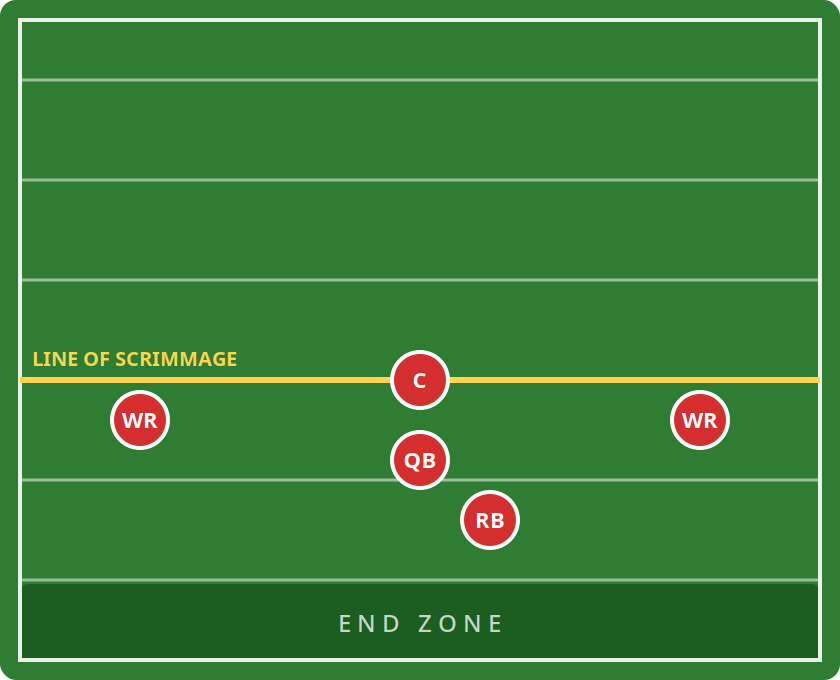
Where to put kids at first: rotate everyone. Don't lock a 7-year-old into one spot. That's the consistent advice across youth coaching, and it matches the FDM: kids develop faster and have more fun trying everything. Put your most reliable hands at center early (bad snaps kill drives), give every kid a turn at the fun spots, and use your first practice to evaluate rather than decide.
What gear you actually need
For the kids: the league almost always provides the flag belts and the game ball. Kids need cleats (rubber studs only, no metal spikes), shorts without pockets, and a mouthguard is strongly recommended. Leagues use age-appropriate ball sizes, often Pee Wee/K2 for younger kids and mini balls for the littlest players.
For you, the coach: a whistle, a dozen cones, a clipboard with your practice plan, and 2–3 junior footballs if the league doesn't supply practice balls. An agility ladder is nice but optional. The standard coach's kit is exactly this list: clipboard, whistle, cones, agility ladder. If you're buying it yourself, the whole kit runs well under $75.
What a practice looks like
A standard youth practice runs about 60 minutes and follows the same rhythm everywhere: warm up with a fun game, work on fundamentals through short drills, install a little team offense and defense, and finish with a scrimmage while the kids are still fresh enough to enjoy it. Keep everything moving. Kids standing in lines get bored and lose focus. This warm-up → fundamentals → team install → scrimmage rhythm is the standard practice structure across youth football.
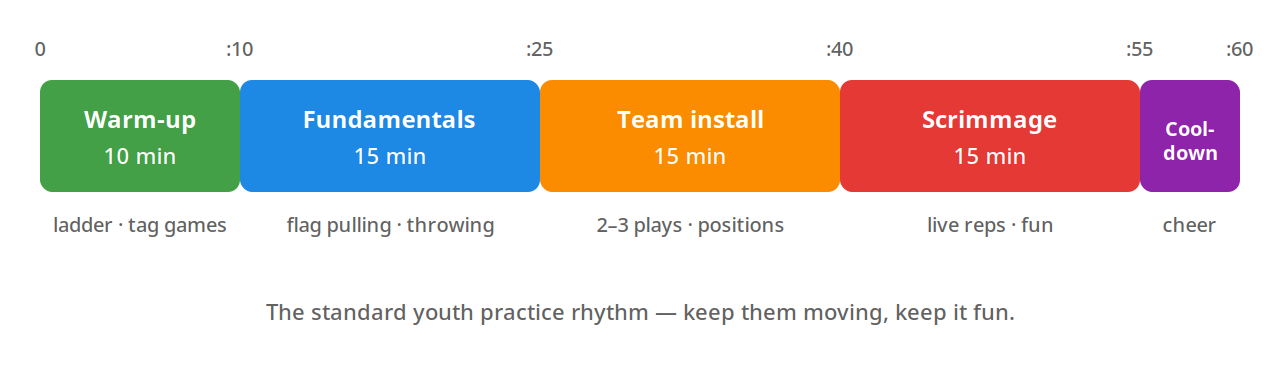
3. Your first-practice game plan
Don't try to teach football in practice one. You have four goals: (1) learn every kid's name, (2) see who can throw and catch, (3) teach the snap and flag pulling, (4) end with something fun so they want to come back.
The high-level flow:
- Open with a fun warm-up game. Tag-style games work great. They're secretly teaching agility and flag pulling while the kids think they're just playing.
- Teach the center-QB snap. You'll be amazed how much practice time clean snaps save you over the season. Ten minutes here pays off for weeks.
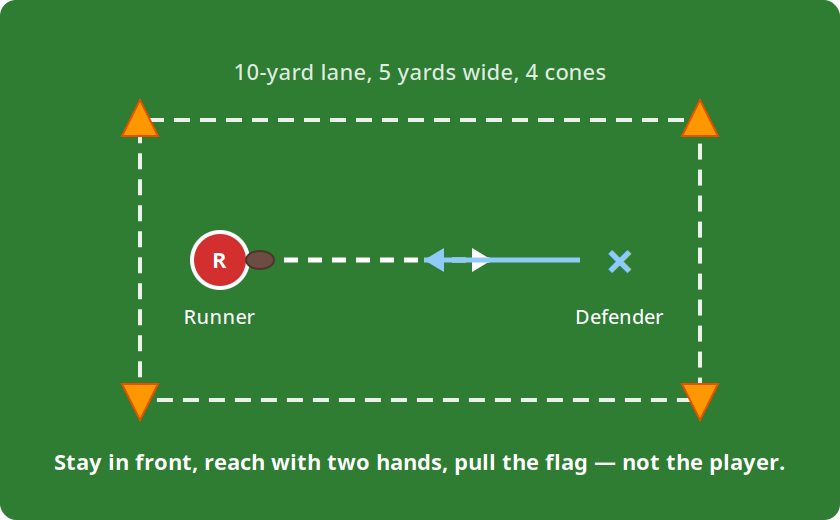
- Run a simple flag-pulling drill in pairs. One kid runs, one kid pulls. Narrow lane, no contact beyond the flag.
- Teach one or two basic pass routes. A slant (run a few steps, cut inside) and a go (just run straight). That's plenty.
- Finish with a relaxed scrimmage or a throwing game. End on a high note, bring the team in, cheer, done.
Two rules for the whole practice: keep your talking to 30-second bursts (demonstrate, don't lecture), and follow USA Football's FDM guidance for beginners: use games and mini-competitions rather than repetitive drills. Kids learn fundamentals faster when they're playing. When you're ready for the full minute-by-minute version, use our first-practice script.
4. The 6 fundamentals kids need
Throwing. Most kids arrive with a sidearm fling. "Good enough" for week one: the ball comes out over the top and travels 10 yards to a teammate. The classic coaching cue is point-step-throw: point the non-throwing hand at the target, step toward it, throw, and follow through.
Catching. Teach eyes first, hands second: watch the ball all the way in, catch with the hands rather than trapping it against the body. "Good enough": catches a chest-high pass standing still more often than not. Dropped balls are normal for weeks. Don't make a big deal of it.
Flag pulling. This is the most important skill in flag football: the equivalent of tackling, and the thing beginners are worst at. The core technique, taught consistently across youth coaches: don't chase — shuffle. Stay low, break down (slow down, get balanced and big) in front of the ball carrier, keep your eyes on their waist and hips, and grab the handle at the very top of the flag belt with your outside hand — not the flag itself, not the shirt, not the shorts. A great starter drill is the shuffle pull: set 8 cones in a zigzag, station a player wearing flags at each cone, and have the defender shuffle cone to cone, staying low, breaking down, and pulling with the outside hand at each stop. Teach it 1-on-1 in a narrow lane of cones before you ever try it in a live scrimmage.
Running routes. Kids only need a handful: the go (run straight), the slant (a few steps, then cut inside), the hitch (run a few yards, stop, turn around), and the out (run a few yards, cut toward the sideline). "Good enough": the receiver runs roughly where the play says and turns to look for the ball. Precision comes later — much later.
Defense basics. The fundamentals that cover most of youth defense: break down and get big (wide stance, shuffle; never cross your feet), eyes on the ball carrier's belly button (not their eyes or shoulders — hips don't lie), stay squared up right in front of the runner, and never let anyone get behind you. Whether your league plays man or zone coverage, beginners just need to know who (or what area) they're responsible for. In man coverage, decide in the huddle and say it out loud: "I've got this one." "Good enough": every defender can point to the player or area they're covering before the snap, and pulls flags from the handle (see flag pulling above).
Sportsmanship. This one is coaching, not technique, and it matters more than any drill. USA Football's FDM is explicit: youth coaches should regularly encourage and congratulate athletes for learning teamwork and life skills, not just for scoring. Set the tone in week one: we cheer for everyone, we never blame a teammate for a mistake, and the other team is our opponent, not our enemy. The parents are watching how you handle this more closely than they're watching the score.
5. What you can safely ignore (for now)
- A big playbook. You need 3–5 simple plays to start, not 40. Master a few; add more when the kids are bored, not before.
- Complex defensive schemes. One base defense, taught well, beats three installed badly.
- Blitz packages and trick plays. Fun for week six. Poison for week one.
- Position specialization. The FDM is blunt about this: young athletes should play multiple positions. Don't label your 8-year-old a center for life.
- Winning. At the youngest FDM stages, USA Football's guidance is explicit: prioritize the experience over wins and losses. Your season is a success if every kid wants to play again next year.
6. Safety non-negotiables
This section follows USA Football's governing-body standards for youth football safety. It is general guidance, not medical advice. When in doubt, sit the kid out and consult a professional.
Concussions. Flag football involves far less head contact than tackle, but concussions can still happen: awkward falls, collisions going for the ball. Know the signs: headache, dizziness, confusion, sensitivity to light, unusual mood or behavior. The rule is absolute: if you suspect a concussion, the player sits out immediately and does not return without medical clearance. No exceptions. No "tough it out." No matter the score. USA Football's coach certification covers concussion recognition as a core module. Consider taking it. It's inexpensive and it's the national standard.
Heat and hydration. Most flag seasons run through warm months. Schedule water breaks every 15–20 minutes whether kids ask or not, watch for flushed faces and fading energy, and move to shade when you can. Heat illness escalates fast in small bodies. When in doubt, stop practice.
Gear and field check. Cleats with rubber studs only. No metal spikes, ever. No jewelry, no hard-brimmed hats on the field; mouthguards strongly encouraged. Walk your practice field before the kids arrive and clear rocks, holes, and debris.
Emergency plan. Before your first practice, know three things: where the nearest phone is, where the first-aid kit is, and which parent holds the emergency contacts. Tell one assistant parent: "If a kid gets hurt, you call 911 while I handle the kid." Thirty seconds of planning beats panic.
7. Your first-week checklist
- ☐ Read your league's rulebook cover to cover (30 minutes now saves hours of confusion later)
- ☐ Confirm your format (5v5, 6v6, or 7v7) plus league-specific twists (no-run zones, blitz rules, QB run rules)
- ☐ Get the roster with parent contact info and any medical notes
- ☐ Assemble your coach's kit: whistle, cones, clipboard, junior footballs
- ☐ Confirm your practice field, day, and time with the league
- ☐ Send parents a welcome message: schedule, what kids should wear and bring, your coaching philosophy in two sentences
- ☐ Watch one beginner-coach video on where to put new players (seeing it beats reading about it)
- ☐ Read our minute-by-minute first-practice script (companion article)
- ☐ Consider USA Football's youth coach certification, the national standard, and it covers safety
You're going to do great. The kids don't need a mastermind — they need an adult who's organized, positive, and prepared. That's a much lower bar than you think, and this site exists to get you over it.
Your Next Step
Your First Practice, Scripted Minute by Minute →
You know what a practice should look like. Now run your first one: exactly what to do and say, from the moment you arrive to the final cheer.
Practice Plans for 6U and 8U →
Ready-made practice plans for the youngest age groups: show up, open the plan, coach.