


5 First Plays for 5v5 Flag Football
You don't need twenty plays. You need five, all run from one formation, so your kids line up the same way every time and only the routes change. That's how real youth coaches do it: same look, different punch.
Everything below is 5v5, the most common youth format. If your league plays 6v6 or 7v7, these five plays are still the right place to start, and the routes work the same way. What changes is the other side of the ball: the defense gets the extra players too, so the windows get tighter, the coverage behind the first level is real, and many leagues add a rusher coming at your quarterback. Same concepts, harder game. Coaching 6v6 and 7v7 well is its own job, and the Complete Season Bundle has a full volume on it.
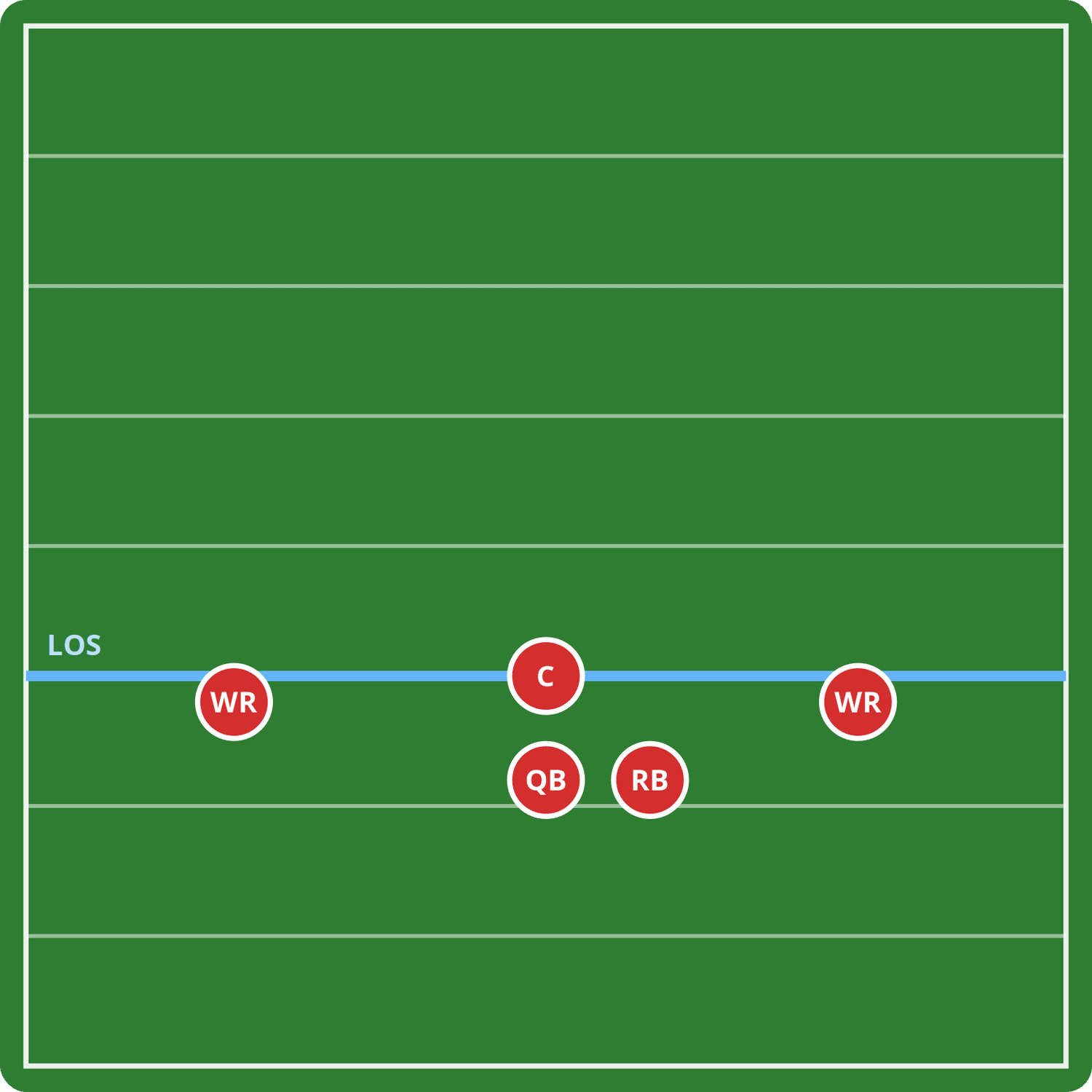
The formation: spread
Line up like this every single snap. No exceptions for the first month.
Center on the ball. Quarterback four yards behind the center, in shotgun. Don't bother with under-center snaps until the exchange is automatic. Two wide receivers, one near each sideline. Running back next to the quarterback.
One rule on every play below: nobody stands still. The center snaps and then runs a short route (or leads the sweep), the running back always releases, and every receiver is running a route, a decoy, or a clear-out, so the defense has to account for all five kids.
That's it. Five spots. Teach the spots before you teach a single play. If a kid can't find his spot in under five seconds, you don't have a play problem, you have a lineup problem. Rep the lineup until it's boring. Then rep it again.
Play 1: Slant
Who does what: Both wide receivers take two steps upfield, then cut hard at an angle toward the middle. The center snaps, then drags underneath the slants and sits in the middle as the checkdown. The running back fakes a handoff step toward the line, then swings to the right flat as the safety valve. The quarterback catches the snap, looks at whichever slant opens first, and throws it to him on the move.
Tell your quarterback: "Watch both receivers running inside. Throw to the one who gets free first." If both slants are covered, the center sitting in the middle is the safe throw.
When to call it: First play of the game, every game. It's the easiest throw in football: short, in front of the quarterback, and the receiver is running toward the ball. If your QB can complete one pass, it's this one.
Coaching cue: "Catch it on the run — don't stop and wait." Receivers who stop turn a slant into a wrestling match with the defender.
Play 2: Out
Who does what: The right receiver sprints seven yards upfield, plants his outside foot, and cuts sharply toward the sideline. The quarterback throws it to the sideline, leading him. The left receiver runs a short slant as a decoy to hold the middle defender. The running back takes the fake handoff, then leaks out to the right flat underneath the out. The center hooks in the middle as the checkdown.
Tell your quarterback: "Look at the out first. If his defender is right on him, throw it to the back sneaking out underneath him." The center's hook in the middle is the third look if both are covered.
When to call it: Second down, when you need five or six yards. The out is the chain-mover. It's open all day against young defenses because the defender has to cover the whole sideline by himself.
Coaching cue: "Plant and go — one cut, full speed." The route only works if the cut is violent. Rounding it off gives the defender time to recover.
Play 3: Hitch
Who does what: The left receiver runs five yards, stops, and turns around to face the quarterback. That's the whole route. The right receiver runs a go route to clear his defender out. The quarterback throws it the instant he turns. The running back swings out to the left as the safety valve. If the hitch is covered, dump it to him. The center snaps, waits a beat, then drags to the right as the second checkdown.
Tell your quarterback: "Throw it the second he turns around. If a defender is standing in his face, don't throw it — swing it to the back instead." The hitch only works against a defender playing off; tight coverage kills it.
When to call it: When the defense starts backing up because they're scared of your slants and outs. The hitch punishes soft coverage: free five yards, all day.
Coaching cue: "Stop means stop." Kids want to drift. The hitch works because the receiver is stationary and the quarterback knows exactly where he'll be.
Play 4: Sweep
Who does what: The quarterback takes the snap and immediately turns to hand off to the running back. No fake, no read, just get the ball to him fast. The back takes it and sprints wide to the right, following the right receiver, who throws a block (screens the defender, no contact needed beyond getting in the way). The center snaps, then sprints to the play side and screens the first free defender. The left receiver runs a go down the back side so his defender can't chase the sweep.
Tell your quarterback: "Get it to him fast, then run the other way like you kept it." Tell your back separately: take it wide at full speed and follow the screen. Your fake pulls one defender away from the run.
When to call it: When the defense is dropping back to stop your passes. The sweep punishes a defense that's back on its heels. And every kid on the team wants to run this one, which means they'll actually block for it.
Coaching cue: "Full speed from the handoff." Sweeps die when the back dances. Take the ball and go — the edge is there for about two seconds.
Play 5: Flood
Who does what: Both receivers go to the same side: one deep, one short. The right receiver runs a deep corner toward the sideline; the running back (or second receiver) runs a short flat route underneath him. The left receiver runs a shallow drag underneath the flood as the checkdown. The center snaps, then hooks in the middle void. The quarterback reads high to low: if the deep guy is open, take the shot; if not, dump it underneath.
Tell your quarterback: "Look deep first. If the deep receiver is covered, throw it short to the back. Never force the deep one." That high-then-low choice is the whole play; the defense can cover one level, not both.
When to call it: Third down, when you need a chunk. The flood overloads one side of the field: two receivers against one or two defenders. Somebody's open. It's simple math.
Coaching cue: "Two levels, same side." The whole concept is spacing: one deep, one short, and the defense can't cover both.

How to install them
Week 1: Formation and Play 1. That's it. Rep the lineup, rep the slant, go home.
Week 2: Add Play 2. Run 1 and 2 until the kids can line up and run both without you telling them where to stand.
Week 3: Add Play 3. Now you have a short game (slant, hitch) and a sideline game (out).
Week 4: Add Play 4 (the Sweep).
Week 5: Add Play 5 (the Flood). Five plays, one formation, whole season of offense.
Don't add a sixth play until all five are automatic. They won't be automatic for a while. That's fine. Five plays run well beats fifteen plays run badly, and it's not close.
Coaching 5- or 6-year-olds?
Scale this back. The Sweep is your play: install it first, and it may be the only one you need all season. The Slant works only if a kid can throw in your league. In many 6U leagues the coach is the quarterback, so you throw the slant yourself and it still works. The Hitch and the Flood wait until 7–8: route timing and a two-level read are next year's skills.
Read Coaching 5- and 6-Year-Olds: What's Different for the full picture, and run the 6U Practice Plan on practice day.
Once they catch on
Kid defenders are honest: whatever beat them twice, they cheat toward it. That's not a problem. It's an opening you built on purpose: all five plays start from the same picture, so a counter looks identical to the original up until the break goes the other way.
Complete the Slant twice and watch the right corner: he's creeping inside, leaning, waiting to jump the throw he knows is coming. Call the same picture again. The receiver takes the slant's first two steps, plants, and breaks back out to the sideline. The corner is sprinting toward the middle, and the ball goes where he used to be. Your quarterback's job barely changes. Only the last two steps are new.
It runs up and down your list. Out, then the Out-and-Up when the corner starts squatting on the break. Hitch, then the Hitch-and-Go when the defender starts charging the stop. Sweep, then the Reverse when the whole defense flows wide chasing it: a defense running one way is a step late coming back.
The three counter plays, drawn route by route, and the full pairs system are in The Season Playbook. The free five get the defense cheating. The counters collect.
Draw your own variations with the Play Designer: same field, your players, your routes.
Your Next Step
Open the Play Designer →
Draw these plays with your own players' names and print wristband cards.
Your First Practice: A Minute-by-Minute Script →
How to walk through your first play inside a real first practice.