


Your First Flag Football Practice: A Minute-by-Minute Script
Print this. Put it on a clipboard. Bring a whistle. When practice starts and your mind goes blank (and it will), just read the next block and do what it says. That's the whole system.
This script assumes 8–12 kids, ages 6–10, and one 60-minute field slot. Adjust the minutes, not the order: movement first, evaluation disguised as fun, two drills, plays, finish with a game.
The night before (10 minutes at your kitchen table)
The rule: walk onto the field with the "I know exactly" mindset. The night before, write down on paper (not in your head) what happens in each block below, and text any assistant coaches who's handling what. Confidence comes from preparation, not from football knowledge.
Pack tonight so you're not scrambling tomorrow: - Whistle, 20+ cones, 2–3 junior footballs - This script on a clipboard - First-aid kit and a phone - A bag of water bottles (or confirm kids bring their own)
Confirm your field, day, and time with the league. Read your league's rulebook once. It's usually 4–6 pages, and it's the final word on everything from downs to blitz rules.
Arrive 15–20 minutes early (non-negotiable)
This is your first impression, on the kids and the parents. When families arrive, the field should already look like a coach runs it.
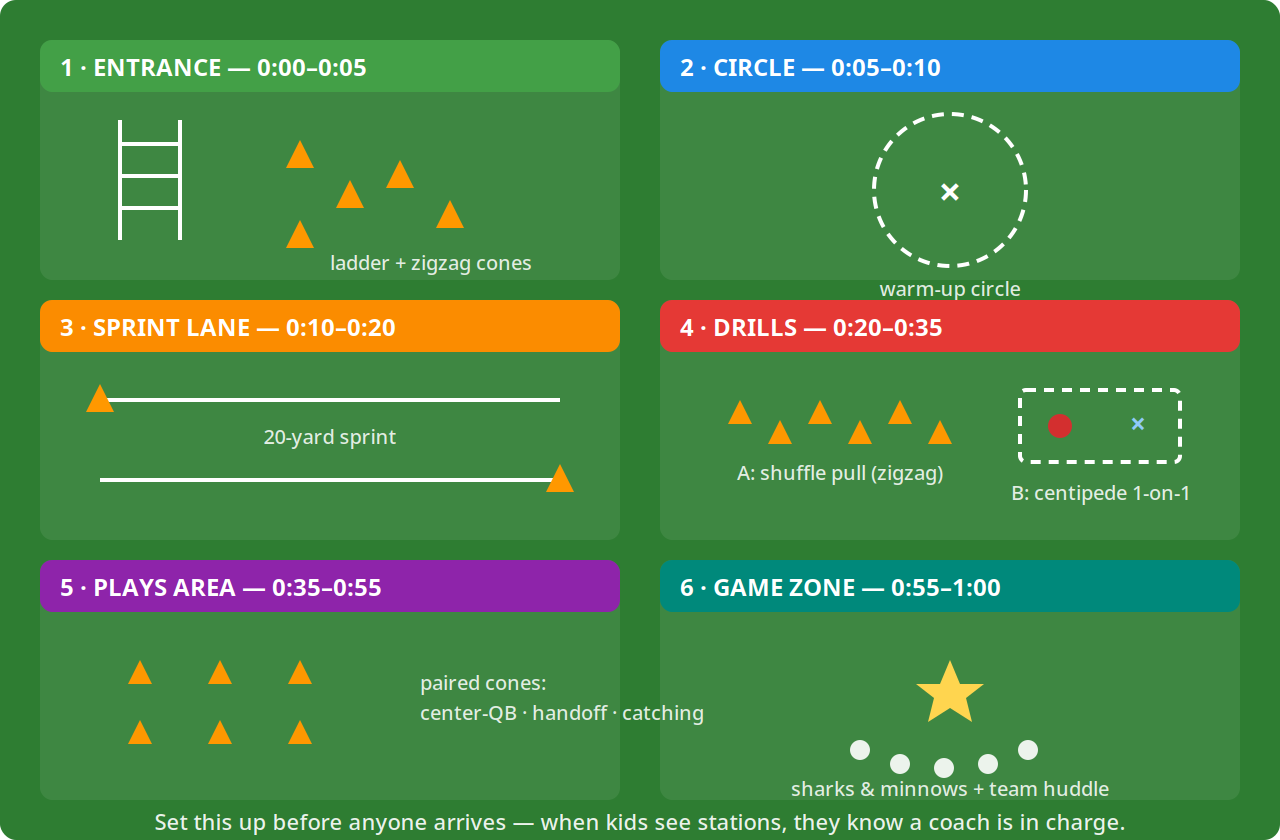
- Walk the field. Clear rocks, holes, and debris from your practice area. Check for sprinkler heads and glass. (USA Football's safety guidance starts here: the field check happens before any kid arrives.)
- Set up your stations (see Diagram 1): agility ladder near the entrance, zigzag cones beside it, a 20-yard sprint lane, two drill areas, and a plays area with paired cones.
- Gear check as kids arrive: cleats with rubber studs only (no metal spikes, ever), mouthguards in, jerseys tucked, flag belts fitted snug around the waist. New belts run tight. That's normal. If a kid's belt is falling off, tighten it now, not mid-drill.
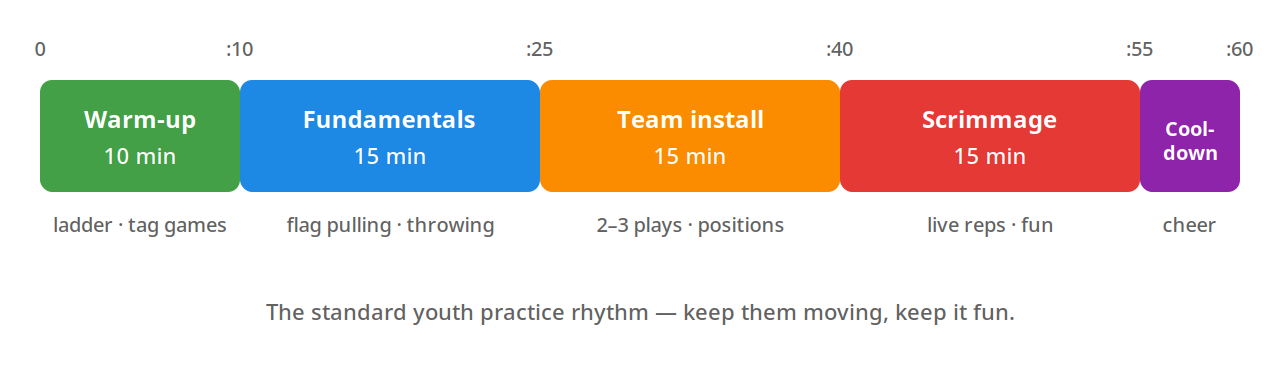
0:00–0:05 | Arrival: keep them moving from minute one
Don't let kids stand around throwing a ball while you finish setting up. As each kid arrives, point them at the agility ladder.
SAY: "Line up right here. When I blow the whistle — GO. Through the ladder, then zigzag those cones, then back to the end of the line."
Run 2–3 kids at a time. The instant one kid finishes, blow the whistle and the next goes. No ladder? Cones work fine. The point is footwork, not equipment.
Why this matters: you're setting the pace for the entire season in the first five minutes. Fast whistle, fast transitions, no standing around. Kids read the energy immediately.
0:05–0:10 | Circle up: warm-up + word of the day
SAY: "Bring it in! Circle up, take a knee."
Run a quick warm-up: 20 jumping jacks, touch your toes, a few stretches. Keep it under 4 minutes. This is a warm-up, not a workout.
Then the word of the day. Pick one word for the whole practice: effort, encouragement, sportsmanship. Many experienced youth coaches do this every practice and recap it at the end; parents love it, and it gives you something to coach besides technique.
SAY: "Today's word is EFFORT. Effort means trying hard even when it's tough. Who can tell me what effort looks like out here?"
Let two or three kids answer. Thirty seconds, then move on. You'll come back to this word at the end.
0:10–0:20 | Evaluation disguised as fun
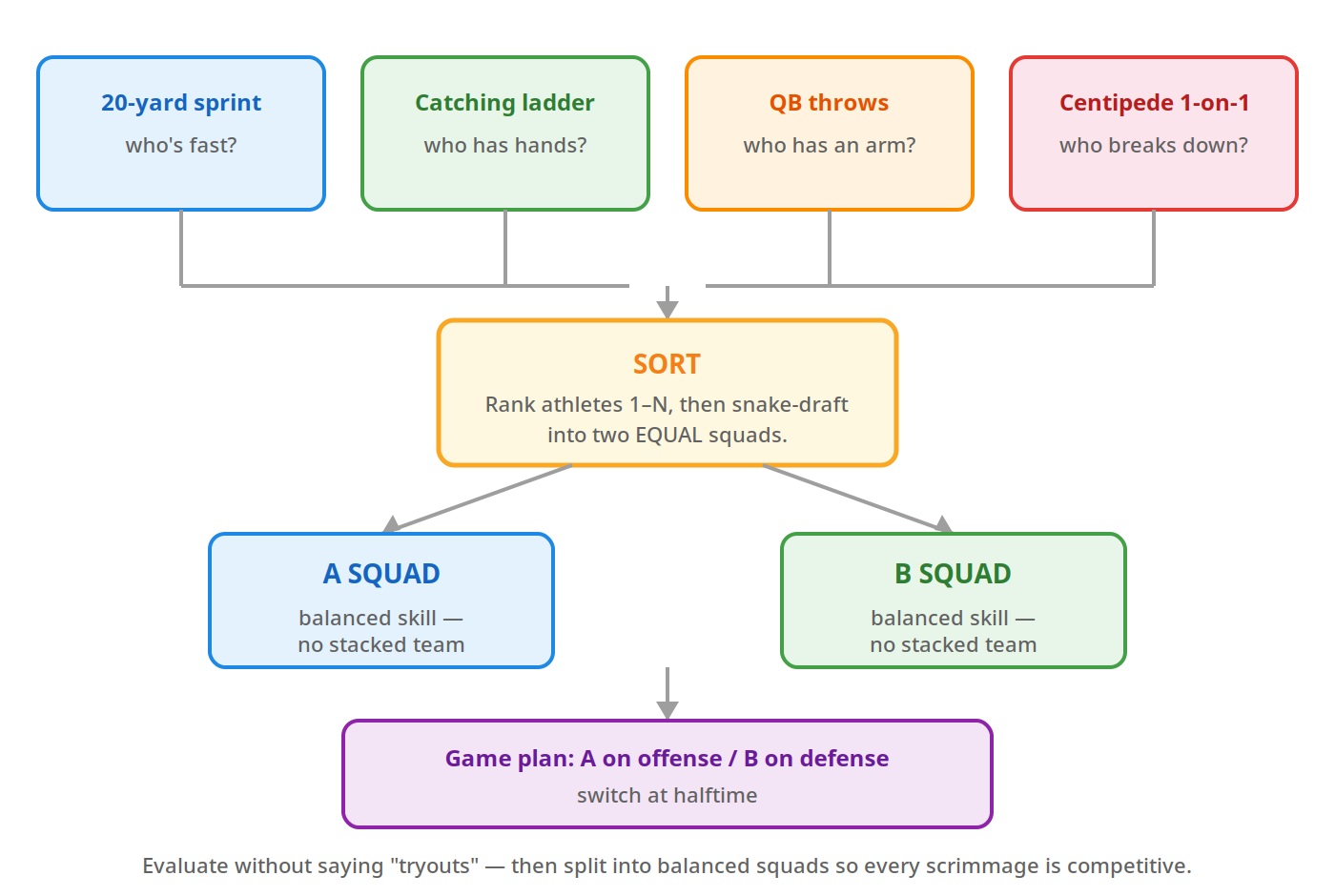
Here's the secret: you're scouting your team right now. But never say "tryouts" or "evaluation." Say games.
SAY: "We're going to play some games so I can learn what you're great at."
1. The 20-yard sprint (3 min). Line everyone up with hands apart for spacing. Race 20 yards, walk back, go again. You're noting: who are the burners? (Future running backs and deep safeties.)
2. Catching ladder (4 min). Pair kids up, 5 yards apart, throw and catch. Every time both catch it, they each take one step back. You're noting: who has hands? Who's afraid of the ball?
3. Who can throw? (2 min). "Who wants to show me their throwing arm?" Let volunteers throw to you. You're noting: anyone with a natural arm? (Future quarterbacks.)
4. Centipede 1-on-1 (3 min). Runner vs. defender in a short cone lane: defender tries to pull the flag. You're noting: who breaks down and shuffles instead of diving? Who actually tries hard?
While they grab water, do your sorting: divide the team into A and B squads of equal skill: your best athlete paired against their best athlete, and so on down the line. Many coaches build these balanced squads at the first practice and use them all season: A on offense, B on defense, switch at halftime. Don't announce the squads yet. You'll use them in the scrimmage at the end.
0:20–0:35 | Two drills (this is where skills get built)
Two drills, ~7 minutes each. Demo each one yourself first. Don't explain it, show it. Kids copy what they see.
Drill 1: Shuffle pull (8 min)
The most valuable drill in youth flag football. Set 8 cones in a zigzag. Station a player wearing flags at each cone. The defender starts at the back cone and shuffles (shuffles, doesn't run) cone to cone, breaking down at each one and pulling the flag with the outside hand, grabbing the handle at the very top of the belt.
Coach it in the moment: "Stay low! Shuffle, don't chase! Eyes on their hips! Grab the handle!"
Run every kid through twice, then have them turn around and go back the other way. This one drill, done weekly, will win you games.
Drill 2: Centipede 1-on-1 (7 min)
Pairs in a short lane of cones. One runner with a ball, one defender. On your whistle, the runner tries to get past; the defender breaks down, stays in front, and pulls the flag. Switch roles. Keep the lanes narrow. Small space forces good technique.
Coaching rule for both drills: praise effort loudly and specifically ("Great breakdown, Maya!"), and correct only one thing per kid per rep. Ten corrections = a kid who stops trying.
0:35–0:55 | Plays: teach positions through reps
Run plays from day one. 100% of your first practice includes plays. If kids only do drills, they'll show up to the game not knowing where to stand. Teach every position through the rep, not before it.
Split into three stations (or run them sequentially with the whole group if you're solo). 6–7 minutes each:
Station 1: Center–QB exchange
SAY: "Centers — you start everything. Quarterbacks — head up, hand out."
Teach a cadence: "Ready… GO!" QB keeps their head up, hand out like a goalpost. Center snaps the ball into the QB's hands, then runs a route. They don't just stand there. Pair everyone up with cones so the whole group reps at once. Five reps each, then switch roles.
Station 2: The bread-basket handoff
The running back makes a basket with both hands at belly height. The QB places the ball into the basket: elbow under, not punching toward the runner's face (watch for this; kids do it wrong constantly). Start at half speed, then full speed.
SAY: "Nice and easy first. Walk it… now half speed… now game speed!"
Station 3: Diamond catching
Receiver puts hands together in a diamond shape. QB grips the ball at the laces and throws it into the diamond. When the ball hits, hands go soft and close around it. Don't catch stiff-armed. Step back after every catch; see how far out the pair can get.
Then: walk through ONE real play (5 min)
Line them up: center, QB, two receivers. QB takes the snap, hands to the running back, running back runs. That's it. No routes, no fakes. Let them feel what a play is: huddle, break, line up, go. They'll be buzzing.
0:55–1:00 | Finish: fun game + cheer + word recap
End with something fun while they still have energy. Never end on a drill.
Pick one: sharks and minnows (one shark pulls flags; caught minnows become sharks), last player standing (everyone in a circle trying to pull each other's flags), or capture the ball (teams race to carry a ball back to their side; flag pulled = drop it and wait 5 seconds).
Then bring them in. This is the most important two minutes of your practice:
SAY: "Bring it in! Take a knee. Remember our word today? EFFORT. Who showed effort out here?"
Let kids name each other. Cheer. Break with a team cheer on three. End on time. Parents notice, and it builds trust for the whole season.
After practice: the parent text (copy, paste, send)
Text your parent group thread within an hour. This is the "transfer of training": skills stick when parents reinforce them at home.
Great first practice today! Here's what we worked on: • Flag pulling (the #1 skill in flag football) • Snapping and handoffs • Catching Word of the day: EFFORT — ask your kid what it means! Next practice: [day, time, field]. Please have them wear cleats and bring a water bottle. — Coach [you]
Thirty seconds of typing. Massive return.
Quick troubleshooting
A kid is crying or shut down. Don't push. Give them a job: cone collector, whistle holder, your "assistant." Most rejoin within 10 minutes once the pressure's off.
It's chaos and nobody's listening. Blow the whistle. Thirty-second reset: "Eyes on me." Then demonstrate the next thing instead of explaining it. Talking is the enemy; showing is the fix.
A parent is coaching from the sideline. Thank them after practice and invite them to help at the next practice as an assistant. Sideline coaching becomes sideline helping.
You run out of time. Cut a drill, never cut the fun game at the end. Kids remember how practice felt, not what they drilled.
Safety notes (non-negotiable)
- Concussions: flag football has far less head contact than tackle, but falls happen. Know the signs: headache, dizziness, confusion, unusual behavior. The rule is absolute: if you suspect a concussion, the player sits out immediately and doesn't return without medical clearance. No exceptions.
- Heat and hydration: water breaks every 15–20 minutes whether kids ask or not. Watch for flushed faces and fading energy.
- Gear: rubber cleats only, no jewelry on the field, mouthguards strongly encouraged.
- Emergency plan: before practice, know where the nearest phone is, where the first-aid kit is, and which parent holds the emergency contacts.
These follow USA Football's governing-body standards for youth football safety. The full briefing is in our beginner's guide. This is general guidance, not medical advice.
Get this practice as a printable PDF
The PDF is this script in clipboard form. Print it, clip it to your board, and coach from paper at the field instead of scrolling a phone while twelve kids wait on you.
It also packs the whole starter kit into one file: this practice script, the 5 first plays, and 5 flag-pulling drill cards. One download, and it works at the field with no signal and no scrolling.
Practices 2–10 are already written for you
The Season Playbook picks up at Practice 2 in this exact minute-by-minute format and runs through Practice 10. It includes the full Game Day Guide (your first game comes before Practice 2), the expanded 5v5 play library, printable drill cards, and wristband play sheets.
$39. One purchase, and the rest of your season is planned.
Your Next Step
Flag Pulling: The Skill That Wins Games →
Your drills block runs on it: the breakdown, the shuffle, and the grab, taught in order.
How to Teach Kids to Throw a Football →
Grip, stance, and the four checkpoints, so your station reps build a real throwing motion.