


What Age Should Kids Start Flag Football?
The short answer
Somewhere between 5 and 7, for most kids.
That's when the bulk of youth leagues start. 6U is the standard entry division just about everywhere, and NFL FLAG's national program runs all the way from 4 to 17. But here's the thing nobody tells you at registration: the number matters less than the kid. A ready 5-year-old will have a better season than a miserable 7-year-old who got signed up because his friends did.
If your kid likes running around with other kids for an hour, they're ready. That's genuinely most of it.
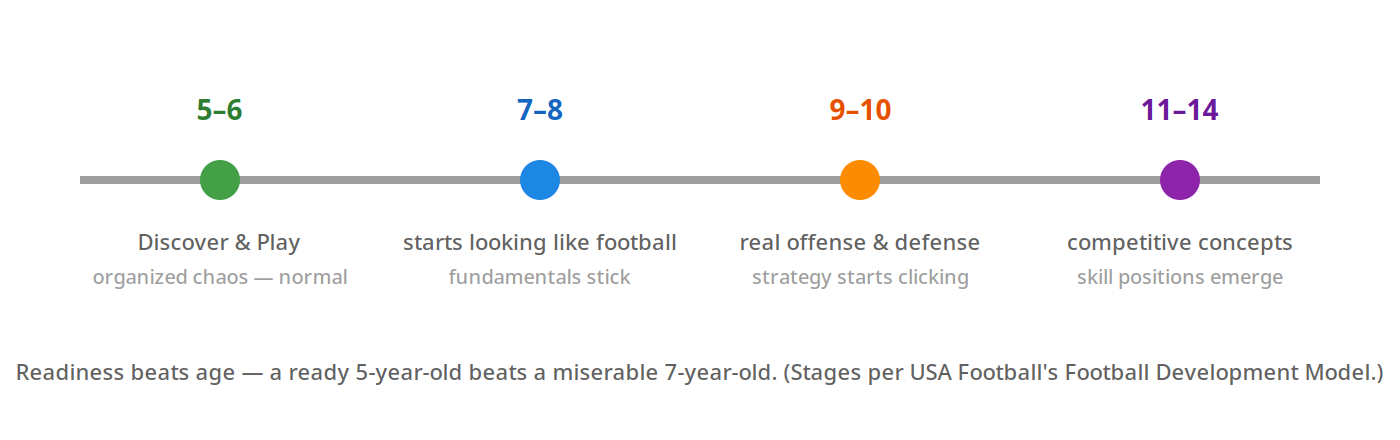
Ages 5–6: organized chaos (and that's fine)
USA Football, the sport's governing body, has a whole framework for this called the Football Development Model. Stage one has a name that tells you everything: Discover and Play.
The prescription for this age: basic movement. Run, jump, throw, catch. No scores. No standings. No competition. Just activity, exposure, and a coach who keeps it fun.
So what can a 5- or 6-year-old actually do on a football field? They can run. They can follow a simple direction for about ten minutes before the wheels come off. They can take turns, mostly. They can definitely have fun.
What should you expect? Chaos. Kids picking grass in the outfield. One kid crying because someone took the ball. Another one doing cartwheels during the huddle. A third asking when snack time is — in the first quarter. All normal. Every 6U coach alive has seen it.
Practices at this age shouldn't look like practice. They should look like recess with a football nearby. Tag games. Relay races. Anything where kids are moving and laughing. The coaches who try to run real drills with 5-year-olds are the ones whose teams fall apart by week three.
One practical note: at this age, keep it to one practice a week plus games. More than that and you're just burning everyone out, including yourself.
Ages 7–8: it starts looking like football
Around 7 or 8, something clicks. Attention spans stretch. Kids can lock in for 15 or 20 minutes at a time. They start remembering what happened last practice.
This lines up with stage two of the development model: Play and Develop. Kids work on what USA Football calls the movement ABCs (agility, balance, coordination, speed), and this is where real flag football fundamentals get introduced for the first time. Throwing motion. Catching with hands instead of the body. Pulling a flag without tackling the kid wearing it.
The scoreboard still doesn't matter. USA Football is blunt about this: at this stage, skill building, participation, and confidence count for more than the final score. If your 8-year-old's coach is screaming about wins and losses, that's a coaching problem, not a kid problem.
This is also the age where kids who start "late" catch up fast. An athletic 8-year-old who's never played will be keeping up with second-year players within a month. The fundamentals at this level are simple enough that one season of decent coaching closes the gap.
What changes for you as a parent: practices get a little more structured, games get a little more real, and your kid will start coming home talking about specific things ("I pulled two flags today") instead of just "it was fun."
Ages 9–10: real football starts
Nine and ten is when team concepts click. Kids this age understand positions. They understand that the play only works if everyone does their job. They can handle losing without it ruining the car ride home (mostly).
Stage three, Develop and Achieve, is built for exactly this: athletes start understanding sport-specific skills, competing in a real way, and learning from mistakes instead of just feeling bad about them.
On the field, this means actual offense and defense. Plays with more than one step. Kids start reading what's happening instead of just chasing the ball. A 10-year-old quarterback can learn to check a first read, then a second. A 10-year-old defender can learn to hold a zone.
A few things stay the same, though. Good youth coaches still rotate everyone through positions at this age. The standard system is two balanced squads that switch offense and defense at halftime, and that runs through about fourth or fifth grade. Nobody should be locked into one spot yet. And nobody rides the bench. Ever.
Playbook-wise, kids this age can handle more than you'd think. By second grade, kids can run a couple dozen plays off a wristband. By 9 or 10, they're ready for real play progressions: same formation, different play, keep the defense guessing.
Ages 11–14: the competitive years
Stage four: Achieve and Advance. The training wheels come off.
Tactical awareness shows up. Kids start understanding why a play works, not just where to stand. Defenses get sophisticated: real zone coverage, blitz timing, halftime adjustments. Adolescence kicks in, which means some kids suddenly get faster and stronger while others haven't yet, and good coaches manage that gap carefully.
This is also when positions get real. Around fourth or fifth grade, coaches start having honest conversations with parents: your kid has a natural arm, let's develop them at quarterback. Your kid is an elite flag puller, let's keep them at linebacker. By sixth through eighth grade, that's the norm: kids play to their strengths, substitutions happen during games, and a player having an off day might sit a few plays.
None of that means the fun stops. The best middle-school coaches still run practices where kids are moving and competing, not standing around. But the kids who love competition finally get to compete for real, and the kids who just love playing still get plenty of that too.
Is my kid ready? Honest signs.
Forget the birth certificate for a second. Here's what readiness actually looks like:
Green lights (sign them up):
- They want to go. Not "tolerate it." Want.
- They can listen in a group for a few minutes without melting down.
- They can handle losing a game of tag without a full crisis. (It doesn't have to be graceful. Just survivable.)
- They can be away from you for an hour without panic.
- They can follow a simple rule ("stay inside the cones") at least some of the time.
Red lights (wait a year):
- The idea of going makes them cry. Not nerves — dread.
- They can't follow group directions at all yet. Not won't. Can't.
- Loud, chaotic environments overwhelm them.
- You're more excited about this than they are. Be honest with yourself on this one.
That last point matters most. At 5 or 6, a single year of development is enormous. A kid who's not ready in the fall might be begging to play by spring. There's no deadline. Nobody's giving out scholarships at 6U.
One more thing: "ready" doesn't mean "good." Your kid doesn't need to be athletic. They don't need an arm or fast feet. They need to want to be there. Everything else is coachable.
For the nervous parent
Let me guess what you're actually worried about. Your kid's never played a team sport. They're on the smaller side, or shy, or clumsy, or all three. You're picturing them standing alone on a field while bigger kids run past.
Here's the reality: 6U flag football is the lowest-pressure team sport in existence. It's non-contact. Everybody plays. Most leagues mandate equal playing time at the young ages. There's no tackling, no getting hit, no bench. The governing body's own model says don't even keep score.
And the bar for the kids? Run around. Listen a little. Have fun. That's the whole list.
Most coaches of young teams expect chaos and plan for it. They're not expecting athletes — they're expecting 5-year-olds. Your shy kid will spend the first two practices figuring out where to stand, and by week four they'll be begging to play quarterback.
Starting at 8, 9, or 10 is completely fine too. Kids pick up flag football fast. The rules are simple, the skills are basic, and a season of decent coaching gets a beginner caught up. Some of the best youth players started "late" because they spent their early years playing soccer or basketball or just running around the backyard. All of that transfers.
The only real mistake is waiting because you're worried they're not ready, when the actual sign of readiness (they want to try) is right there.
Your Next Step
Start Here: The Beginner's Guide →
Your kid is signed up: now the full roadmap from zero to your first practice.
Your First Practice: A Minute-by-Minute Script →
What that first hour actually looks like, minute by minute.