


Flag Football Rules for Kids: The 10-Minute Parent Version
You just volunteered to coach, and you've realized you don't actually know the rules. Good news: you can learn everything that matters in about ten minutes. This is the plain-English version: no rulebook jargon, no tackle-football assumptions.
One thing first, and it's the most important sentence in this article: your league's rulebook is the final word. Youth flag football rules vary from league to league, sometimes a lot. What's below is the consensus across the NFL FLAG framework and multiple youth leagues. Where leagues commonly differ, I'll say so out loud. Then go read your league's rulebook (it's usually 4–6 pages) and note the differences.
1. The game in 60 seconds
Flag football is football without tackling. Each player wears a belt with two flags around their waist. Pull one flag off the ball carrier, and the play is over. That's the whole concept. Everything else is details.
- Players: 5-on-5 is the most common youth format (6v6 and 7v7 exist too; your league will tell you which).
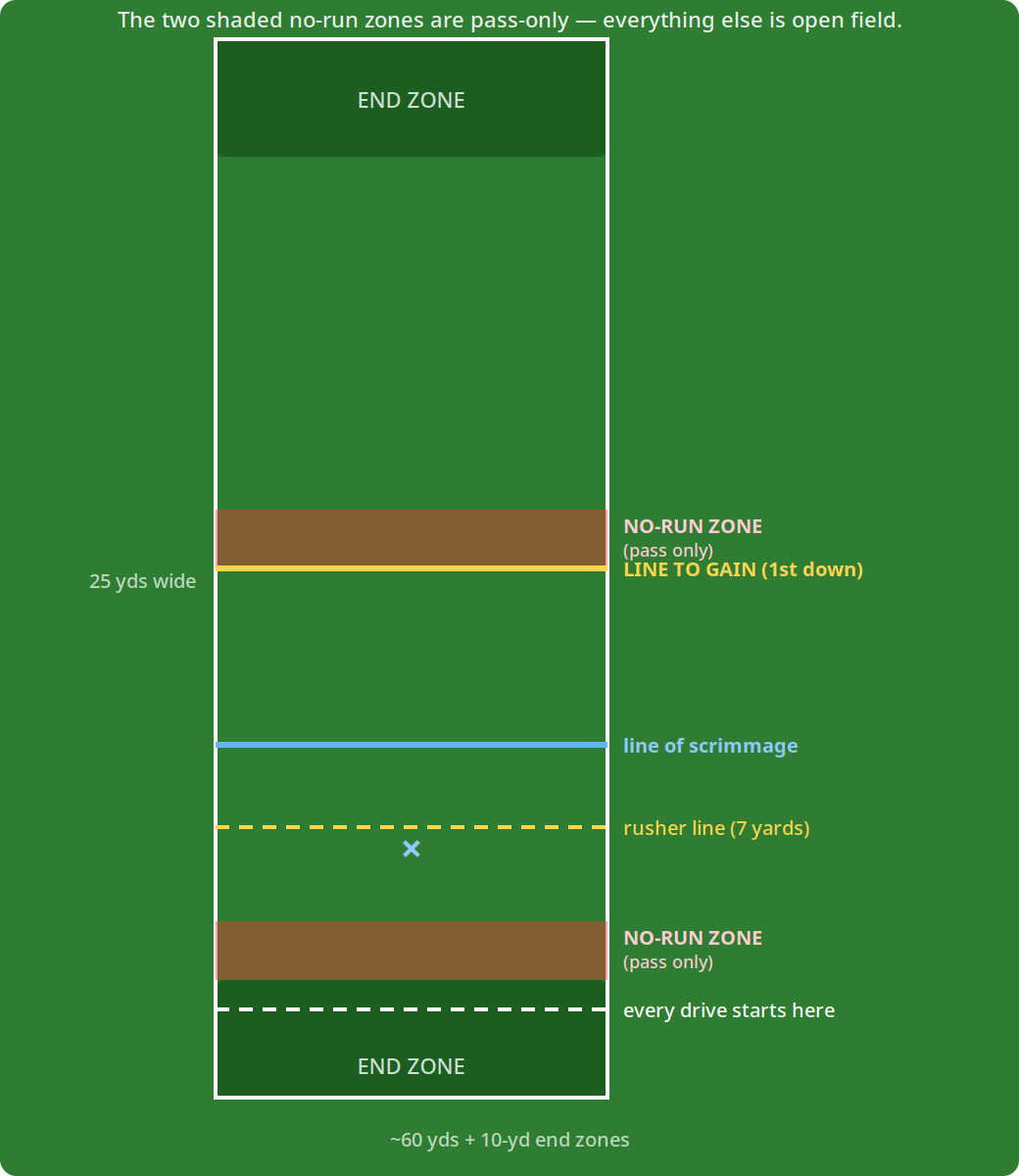
- Field: shorter than a tackle field. NFL FLAG uses 25 yards wide by 64–70 yards long with 7- or 10-yard end zones; many local leagues play on roughly 50-yard fields. Exact dimensions vary by league.
- Clock: two halves with a running clock. Total game time varies widely. NFL FLAG regular season is two 24-minute halves; many community leagues play two 20-minute halves; some tournaments play much shorter games.
- No kickoffs, no punts, no field goals in most youth leagues. Every possession starts at the offense's own 5-yard line.
- Objective: drive down the field and score. The offense gets a set number of tries (downs) to cross midfield, then a set number to score.
2. Downs and scoring
Downs: the offense starts at its own 5-yard line and gets 4 downs to cross midfield. Cross midfield and you earn a fresh set of downs to score (3 downs under NFL FLAG rules), though some leagues allow 4. (League varies; check yours.)
If the offense fails: on most 4th downs the team can "punt" (possession flips, other team starts at its 5) or go for it (fail, and the other team takes over at the spot). Your league's rulebook spells out the exact mechanics.
Scoring:
- Touchdown = 6 points.
- After a touchdown, you choose: a 1-point conversion from the 5-yard line (pass only) or a 2-point conversion from the 10-yard line (run or pass).
- Safety = 2 points. This happens when the ball carrier is downed in their own end zone (flag pulled, knee down, etc.).
- Interceptions can be returned for a touchdown (6 points) in most leagues, but some leagues blow the play dead at the spot of the interception. (League varies.)
3. How a play ends
The whistle blows and the play is dead when any of these happen:
- A flag is pulled (the big one). Ball is spotted where the flag was pulled (technically, where the ball was at that moment).
- The ball carrier steps out of bounds.
- A knee, arm, or any body part (other than hands/feet) touches the ground.
- A flag falls out on its own. The runner is down immediately, ball spotted where the flag lands.
- The ball hits the ground. Fumbles are dead balls in flag football: the ball is spotted where it hit the ground. Nobody dives on loose balls. Ever.
- The 7-second pass clock expires (see section 7).
- A receiver catches the ball while missing a flag: dead at the spot.
- The ball carrier dives, leaps, or hurdles: the play is blown dead where they left their feet. (Exception: a player can dive to catch a pass or dive to pull a flag, just not to advance the ball.)
4. The no-contact rules
This is where tackle-football instincts will betray you. There is no tackling, no pushing, no shoving, no holding, and no stripping the ball from the carrier. Defenders may not run through the ball carrier to get a flag.
No blocking or "screening." Offensive players without the ball may not intentionally get in a defender's way. They have to get out of the way or stop once the ball crosses the line of scrimmage. (Note: some high school and older leagues allow limited blocking. In youth leagues, it's a penalty.)
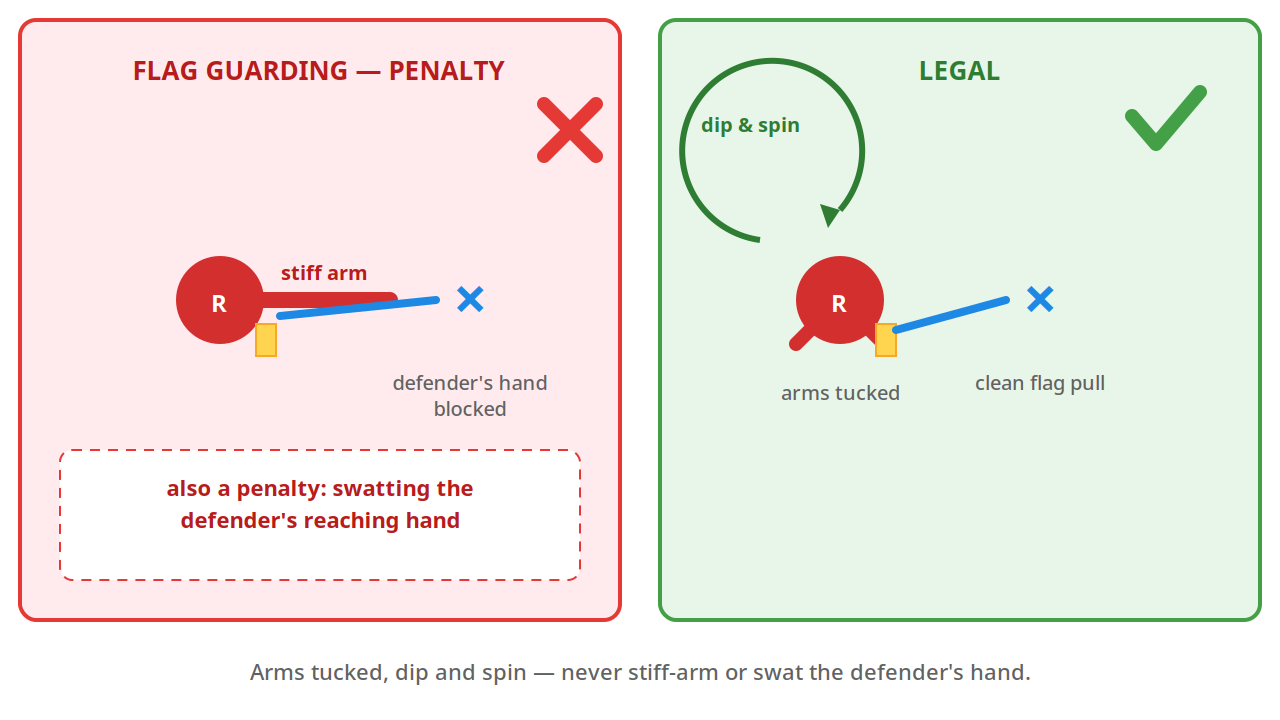
Flag guarding: the penalty your kids will commit most. The ball carrier may not block the defender's access to the flags. That means:
- No stiff-arming.
- No swatting the defender's hand away.
- No dropping the elbow, head, or shoulder to shield the flags.
- No covering the flags with the jersey (tuck it in) or using the ball as a shield.
- Deliberately obstructed flags (untucked jersey hanging over them) count as flag guarding too.
What IS legal: dips, spins, cuts, and jump cuts. Spinning away from a defender is explicitly fine. Ball carriers should also make an effort to avoid defenders who have established position. No charging straight through people.
5. Passing rules
- One forward pass per play, thrown from behind the line of scrimmage. The ball must leave the QB's hand before they cross the line, and the pass must cross the line of scrimmage (unless a defender tips it).
- Shovel passes are legal as long as they're thrown forward from behind the line and caught beyond it.
- No intentional grounding. The QB can throw the ball away past the line of scrimmage to avoid a sack.
- Laterals (backward passes): unlimited behind the line of scrimmage. Whether laterals are allowed past the line of scrimmage varies by league. Some allow them anywhere, others restrict them to behind the line only. (League varies; this one genuinely differs, so check.)
- Everyone is an eligible receiver, including the center. And here's a fun one: if the QB hands off or laterals behind the line, the QB can then go out for a pass themselves.
- Anyone who receives a handoff or lateral behind the line can throw a forward pass from behind the line. Trick plays are legal; just keep the one-forward-pass limit in mind.
- Catching: a receiver only needs one foot (or any body part other than the hand) down in bounds with possession. If offense and defense catch it simultaneously, the tie goes to the offense.
6. Rushing the quarterback
- The designated rusher(s) must line up at least 7 yards behind the line of scrimmage in most youth leagues. (Some older leagues use 1 yard.)
- Usually up to 2 players may rush. They must raise a hand before the snap to identify themselves, and they must rush immediately. No delayed blitzes.
- In the youngest divisions (NFL FLAG's 8U-and-under / 1st–3rd grade), defenders may not rush the passer at all. The 7-second clock (section 7) is the only pressure.
- Once the ball is handed off or lateraled behind the line, the 7-second clock turns off and ALL defenders may cross the line of scrimmage.
- The offense may not impede the rusher's path to the QB. The rusher gets a straight line from their starting spot to the quarterback. If an offensive player moves into it, that's a penalty on the offense.
- A sack happens when the QB's flag is pulled behind the line of scrimmage. Ball spotted where the flag was pulled.
7. Special youth rules
These are the rules that make youth flag football its own game:
- The 7-second pass clock. The QB has 7 seconds to throw. If the clock expires, the play is dead, the down counts, and the ball goes back to the line of scrimmage. The clock turns off the moment there's a handoff or lateral. (Some leagues shorten the clock for older divisions, so check yours.)
- No-run zones. The 5 yards before midfield and the 5 yards before the end zone are pass-only: no running plays across the line of scrimmage from inside these zones. (Each drive only approaches two of them: one to gain the first down, one to score.)
- The QB can't just take the snap and run. The quarterback must hand off or pass first. No QB sneaks straight ahead. (Some 7v7 leagues do allow QB runs. League varies.)
- Gear rules: mouthguards required in most leagues, jerseys tucked in, no pockets on shorts, and flags can't be the same color as the shorts.
8. The 5 rules new coaches get wrong
1. Assuming NFL (tackle) rules apply. There are no first-down chains, no kickoffs, fumbles are dead balls, and receivers only need one foot in bounds. If your instincts come from watching the NFL on Sundays, reset them.
2. Not reading the league rulebook. It's usually 4–6 pages. The variations flagged throughout this article (downs after midfield, laterals past the line, interception returns, QB run rules) are exactly why. Thirty minutes of reading now saves hours of confusion (and arguments) later.
3. Flag guarding. Kids will stiff-arm and swat at hands on pure instinct. It's a penalty every time. Teach them early: arms tucked, dip and spin instead.
4. Fumble pile-ups. There are none. When the ball hits the ground, the play is over. Teach your kids to stop and wait for the whistle instead of diving into a scrum. The scrum habit comes from watching tackle football and it has no place here.
5. The QB can't scramble forever. Between the no-run rule for QBs and the 7-second pass clock, your quarterback has to get rid of the ball. Design your first plays around quick, short throws, not five-second dropbacks.
9. Your league's rulebook is the final word
Here's everything in this article that commonly varies by league: check each one in yours:
- Downs to score after crossing midfield (3 vs. 4)
- Total game length and half length
- Field dimensions and end zone depth
- Laterals past the line of scrimmage (allowed vs. behind-the-line only)
- Interception returns (returnable vs. dead at the spot)
- QB run rules
- Rusher starting distance and how many may rush
- Pass clock length
- Blocking rules (almost always banned in youth, but not everywhere)
Print your league's rulebook, read it once, and keep it in your coaching bag. If a parent or an official questions a call, "let me check the rulebook" beats arguing every time.
Your Next Step
Flag Football Positions, Explained →
Now that you know the rules, here's who plays where, and where to put first-timers.
Start Here: The Beginner's Guide →
New to coaching? This is the full roadmap from zero to your first practice.