


Flag Football Positions Explained (5v5, 6v6, 7v7)
Your league just told you you're coaching 6v6. Or was it 5v5? Your roster has eleven kids, three of whom have never touched a football, and practice is Thursday. Let's sort out who goes where.
The one rule: everybody rotates
Most new coaches get this backwards. They watch one practice, decide the fast kid is the running back and the tall kid is the wide receiver, and lock it in for the season. Don't do that.
USA Football's youth development model is blunt about it: young kids should play multiple positions. Early specialization doesn't just bore them. It slows them down. A kid who only ever plays center never learns to catch. A kid parked at safety all season never learns what the quarterback sees.
So the rule is simple. Everybody tries everything. You'll still put kids where they can succeed on game day (that's coaching), but practice is for rotating, and nobody owns a position at age eight.
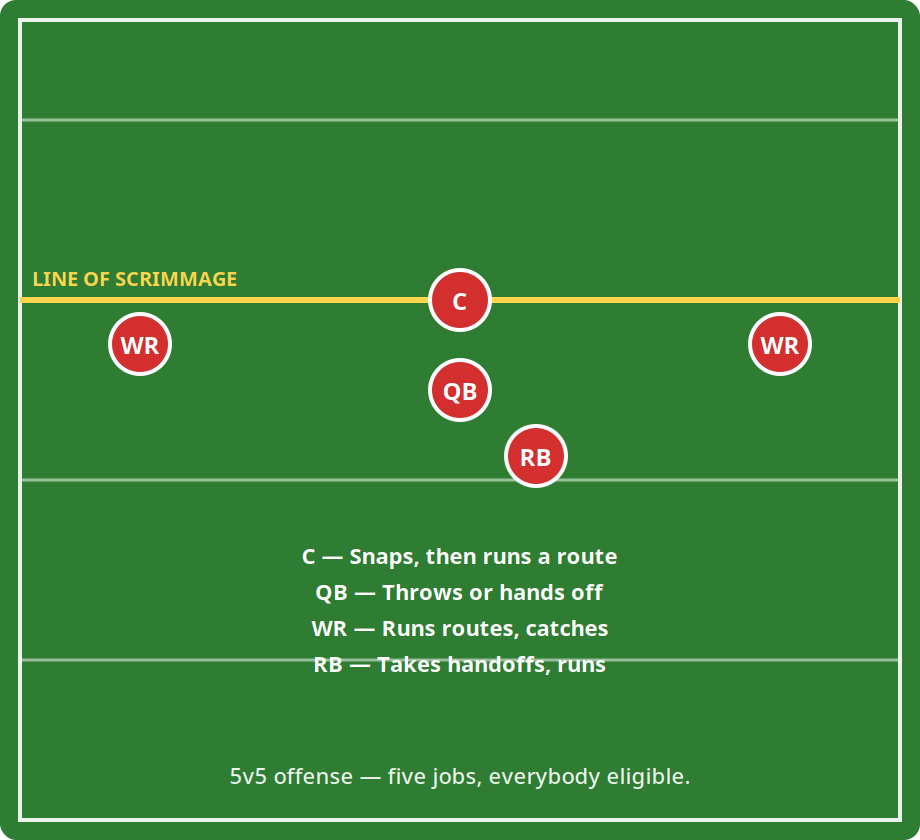
5v5 offense: five jobs
Quarterback. Takes the snap, then throws or hands off. That's the job description, but the real job is bigger. The QB is the kid who can handle the huddle: calls the play, keeps the series moving, doesn't panic when the first read is covered. Pick the kid with the best arm who can also think. Arm alone isn't enough if they freeze.
One practical note: keep your QB in for the whole series. All four downs. Swapping quarterbacks mid-series confuses everyone, especially the quarterback.
Center. Snaps the ball, then becomes a receiver. This is the most underrated job on the field. A bad snap kills the play before it starts. The QB's chasing the ball, the timing's gone, the kids are laughing. Put your most reliable hands here first. Not your biggest kid. Your most dependable one.
Wide receivers (usually two). Run routes, catch passes. That's it, and it's plenty. Your best hands and fastest feet live here.
Running back. Takes handoffs, runs. The kid who can juke in a phone booth but can't catch a cold? Running back. Speed and wiggle matter more than hands here.
One more thing: in flag football, every offensive player is an eligible receiver, including the center. So that dependable kid you put at center because of their hands? They still get to run routes after the snap. Nobody's stuck. (In most youth leagues there's no blocking at all, so nobody's stuck doing that either.)
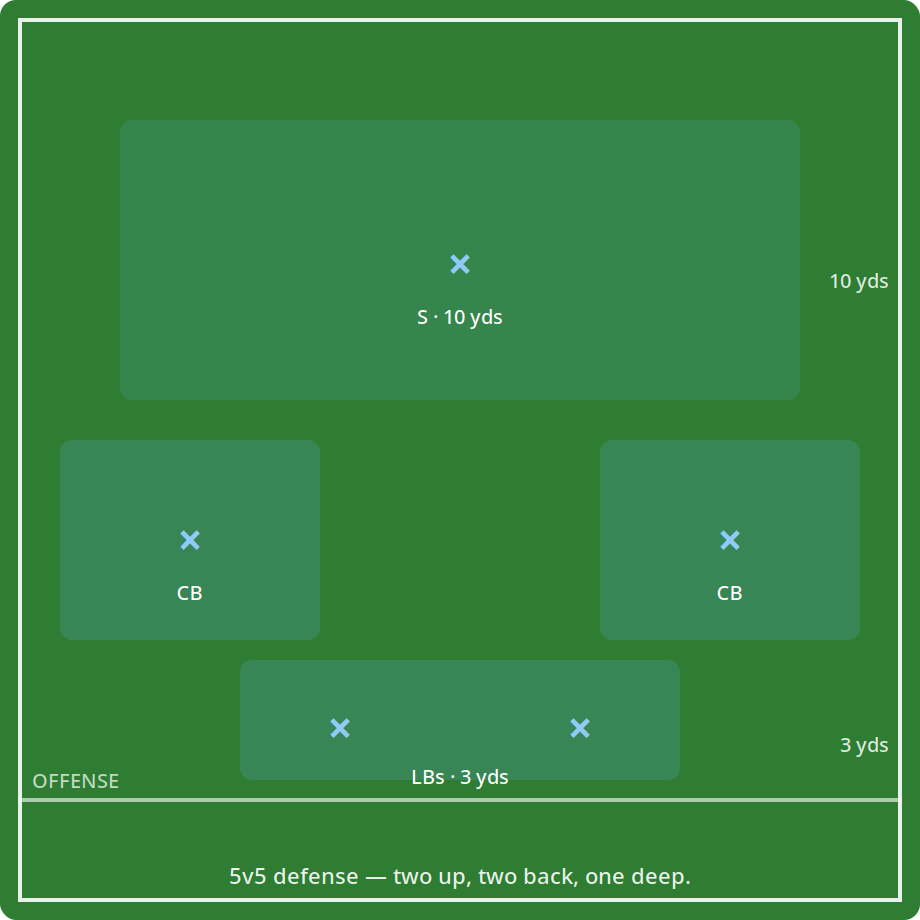
5v5 defense: five jobs
Rusher. Lines up at least seven yards behind the line of scrimmage (that's the rule in most youth leagues) and charges the quarterback after the snap. One rusher is plenty. And here's what new coaches miss: the rusher's job isn't always to pull the flag. Forcing the QB to throw early, or flushing them toward their weak side, is a win. Pressure counts.
Defensive backs (usually two). Cover receivers. The cardinal rule: never let anyone get behind you. If a receiver goes deep, the DB turns and runs with them: shuffle back five yards, then turn and go, staying within a yard. Teach them to stay square, keep a wide stance, and watch the receiver's belly button. Not the eyes, not the shoulders. Hips don't lie.
Safety. The last line of defense. Lines up deep, around ten yards off the ball, and cleans up whatever gets through. This is your fastest kid with the best field awareness. The one who doesn't bite on fakes, reads the quarterback's eyes, and can see the whole field at once. If your defense has a captain, it's the safety.
A note on blitzing: one blitzer at a time. When someone blitzes, somebody else slides over to cover the hole they left. Never leave the deep middle empty. That's where touchdowns come from.
6v6: what changes
Not much. You add one player per side.
On offense it's usually an extra receiver, or a second running back if you've got two kids who can run. On defense it's usually a middle linebacker: a kid who lines up five or six yards back, drops with the play, and helps against both run and pass. Think of them as the utility player. Agile, aware, not necessarily the fastest kid on the team.
If you're coaching 6v6, run your 5v5 concepts and plug the extra kid into the spot that fits. Don't overthink it.
7v7: what changes
Now it's a passing game. Seven-on-seven is usually pass-heavy. A lot of leagues don't allow handoffs at all, though some do.
Offense: quarterback, center, and five eligible receivers. Some teams use a running back who runs routes instead of taking handoffs. Spacing matters more here than in any other format. Spread the field, give the quarterback lanes to throw into, and don't bunch everyone within ten yards of the ball.
Defense: a mix of linebackers and defensive backs, often in a 2-3-2 look: two up front, three across the middle, two deep. Zone coverage is your friend at this level. Each defender owns an area, they hand receivers off as they cross zones, and the safeties keep everything in front of them.
Where to put first-timers
You don't know these kids yet. That's fine. Your first practice is for learning, not deciding.
Start with the snap. Put your most reliable hands at center for the first scrimmage. Everything else can wait. A clean snap makes every play work, and a bad one ruins all of them.
Evaluate, don't decide. Run your sprints, your catching ladder, your 1-on-1 flag-pulling drill. Watch who can throw, who has hands, who's fast, who actually tries hard when nobody's watching. Take notes. Then sort the team into two balanced squads (A and B, equal skill, best matched against best on down the line) and scrimmage. A on offense, B on defense, switch at halftime.
Give everyone a turn at the fun spots. Every kid runs with the ball. Every kid tries quarterback in practice. You'll figure out fast who belongs where, and the kids will tell you with their energy.
Shut down the lobbying early. Some kid will come up before the first game and say "I want to be quarterback." Tell them straight, kindly, in front of the team: the coach decides positions, and everyone gets their turn. Say it once. If you don't, you'll hear about it all season, from the kids and the parents.
What changes as kids get older
As kids get older (often around fourth or fifth grade), the pure-rotation phase starts to wind down. You'll notice it before anyone tells you. One kid is clearly the quarterback. Another lives to pull flags. Another can't catch but runs like the wind. That's not a problem. That's development working.
This is when you start putting more energy into each kid's natural position, and when you talk to parents about it before it happens, not after. "We're going to start developing the positions where each kid is strongest." Nobody should be blindsided on game day.
It doesn't mean benching anyone. The kid who's incredible at flag pulling plays linebacker most of the game, and still gets turns elsewhere. The kid with the arm plays quarterback, and still rotates through. Equal heart, different roles.
And if someone's sitting too long, fix it. There's always a spot. Every veteran coach has the same story: the benched kid who went in at center, ran one hook route, and scored twice. Keep everyone in the game.
Your Next Step
Defense 101: Your First Defense →
Now that you know who plays where, here's the simple zone to line them up in.
Your First Practice: A Minute-by-Minute Script →
Positions get taught through reps: this script builds them into your first hour.