


6U Practice Plan (Ages 5–6): Fun First
Your roster is ten five-year-olds. One of them is crying because his shoelace is untied. Another one is doing cartwheels. A third just asked when snack time is, and practice hasn't started yet.
Welcome to 6U. Here's how you survive it, and how the kids end up loving football.
1. The golden rule: if they're not laughing, they're not learning
Forget everything you know about "practice." At this age, practice is recess with a football nearby. USA Football's youth development model is blunt about the youngest stage: the whole point is fun and basic movement: run, jump, throw, catch. No scores. No standings. No competition. Kids this age rotate through everything; nobody owns a position.
One league's 6U rulebook puts it better than any coaching manual: at this age there is no champion, so make it about the kids — not the coaches, not the parents.
The practical version: a 5-year-old's focus lasts a few minutes at best. So you never run anything longer than ten minutes. You never talk longer than thirty seconds. And you never, ever have kids standing in a line watching other kids do the fun thing.
Your job this season is one sentence long: make every kid want to come back next week.
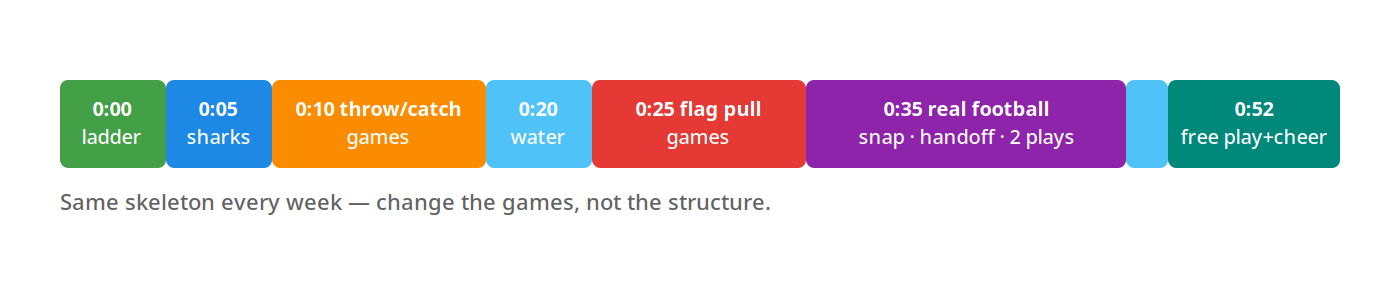
2. The 60-minute plan
Same skeleton every week. Kids this age love routine. The structure stays, the games change. Get there 15 to 20 minutes early and set everything up before a single kid arrives. When they see stations and cones, they know a coach is in charge.
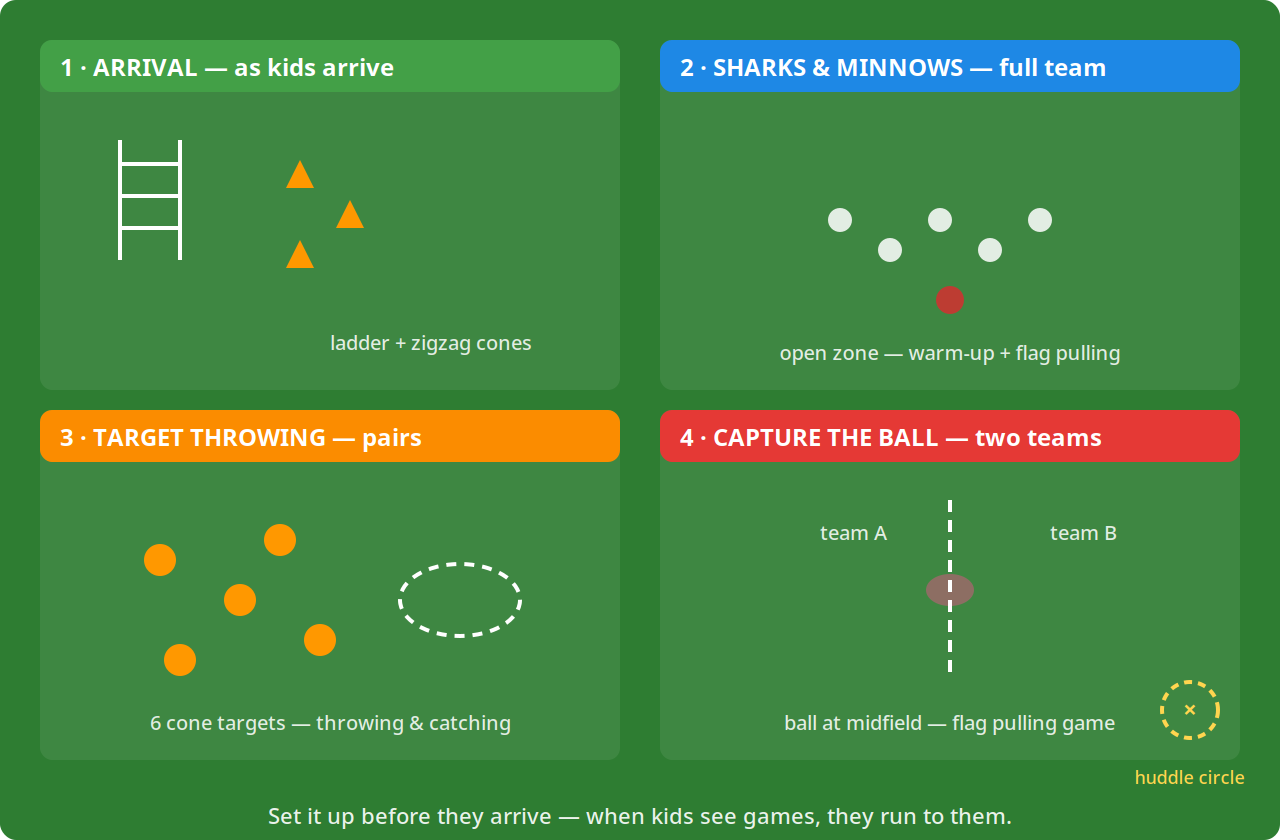
0:00–0:05 | Arrival: the ladder. As kids wander in, point them at an agility ladder laid flat on the grass. They run through it, then cut through a little zigzag of cones. Blow the whistle as each kid finishes — next one goes immediately. No waiting, no instructions longer than "run through the fast feet thing, then zigzag the cones." This buys you five minutes to greet parents and find the kid who's still in the parking lot.
0:05–0:10 | Warm-up game: sharks and minnows. One shark (you, first), everyone else is a minnow trying to cross the field without getting their flag pulled. Pulled minnows become sharks. That's it. They're sprinting, cutting, and pulling flags, and they think they're just playing. First round, skip the flags and play plain tag if half the kids don't have belts on yet. Nobody cares.
0:10–0:20 | Game 1: throwing and catching. Two games, five minutes each.
Knock 'em down: stand up six cones, kids take turns throwing a junior football to knock them over. Step back two steps every round. They're learning to throw over the top without a single word about mechanics.
Partner catch: pair them up, three yards apart. Show them the diamond: hands together, thumbs and pointer fingers touching, like a diamond. You throw it into the diamond, hands go soft when it lands. After every catch, both kids take one big step back. See how far apart they can get before someone drops one. Dropped balls are normal for weeks. Don't make a face.
0:20–0:25 | Water break and the word of the day. Water first, always. Then one word: effort, kind, try. Thirty seconds. "Today's word is TRY. Trying means you go even when it's hard. Who tried hard in sharks and minnows?" Two kids answer. Done. You'll ask them about it again at the end.
0:25–0:35 | Game 2: flag pulling. This is the skill that matters most in flag football, and 6U kids learn it by playing, not by drilling.
Sharks and minnows, flag edition: same game as warm-up, but now everyone's wearing flags and the sharks pull instead of tag. The technique teaches itself: stay in front, grab the handle at the top of the belt.
Capture the ball: ball in the middle, two teams on opposite sides. Carry it back to your side. If your flag gets pulled, drop the ball, run back to base, count to five, jump back in. Pure chaos, and every kid pulls twenty flags without noticing.
0:35–0:50 | "Real football": the snap, the handoff, and two plays. This is the only part that looks like football, and it's still a game.
Teach the snap in pairs: center and quarterback, cones marking where to stand. Cadence is "ready… go." The QB holds one hand out like a goalpost and keeps their head up. The center snaps, then runs a route. They don't just stand there. Five reps, then switch. Everybody snaps, everybody catches.
Teach the handoff with the bread basket: the runner makes a basket with both hands, and the quarterback places the ball in it. The big correction: the QB's elbow goes under, not punching toward the runner's face. Start at half speed. They'll get it wrong the first six times. That's fine.
Then run two actual plays. Show the play on a card in the huddle, a picture, not words. Line them up, run it, cheer like they won the Super Bowl, run it again with different kids in the spots. Many 6U leagues have the coach play quarterback at this age, check your league's rules, since formats vary.
0:50–0:52 | Water. Yes, again. They're five.
0:52–1:00 | Free play and the cheer. Last-player-standing: everyone in a big circle, all wearing flags, trying to pull each other's flags. Lose both flags and you're out. Last one standing wins. Then bring it in, take a knee, and ask: "Who showed TRY today?" Let them name each other. Cheer. Done.
That's the whole practice. Nobody stood in a line. Nobody got lectured. Everybody touched the ball.
3. What NOT to do
No lines. If more than three kids are standing around watching, you've already lost them. Split everything into pairs or small groups so everyone moves at once.
No lectures. Thirty seconds of talking, then show them. If you catch yourself explaining, stop mid-sentence and demonstrate instead. Kids this age learn by watching and doing, full stop.
No score, no standings, no cuts. Nobody's keeping track, and if a parent starts, shut it down kindly. The kids don't care who won. They care whether it was fun.
No yelling at mistakes. A dropped pass, a wrong way run, a flag pulled off the wrong kid, all normal. Correct it once, lightly, in the moment, and move on. The kid who gets yelled at in week one doesn't come back in week three.
No positions. Everybody tries everything. The kid you decided was "the fast one" in week one might be your best catcher by week four. You don't know these kids yet.
Don't coach your own kid harder. Every parent-coach does this. Catch yourself. Your kid gets the same corrections as everyone else, in the same tone.
4. The parent sideline brief
Send this before practice one. It prevents ninety percent of sideline problems.
Tell them what to bring: cleats (rubber studs, no metal), water bottle, mouthguard, shorts without pockets. Tell them what the league provides: flags and balls. If anyone needs gear advice, cleats matter more than anything. Half the kids show up in slippery sneakers.
Tell them what success looks like: "Every kid touches the ball. Every kid tries everything. Nobody keeps score." If a parent knows the philosophy up front, they won't coach from the sideline.
Tell them the sideline rule, kindly: cheer, don't coach. One voice — yours. Kids can't hear two play-callers, and the one they listen to is usually the louder parent.
And collect two things: any medical notes (asthma, allergies, braces; kids with braces need a special mouthguard), and a phone number where they can actually be reached during practice.
5. The four-week progression
Same skeleton every week. Change the games, not the structure.
Week 1: survive. Learn every kid's name. Get flags on and fitted (tuck the jersey in first, snug around the waist, write their name on the belt with a sharpie so lost flags come back). Run the games. Don't teach a single play. If practice ends and nobody cried, you won.
Week 2: add the snap and the handoff. Same games as week one, then the center-QB pairs and the bread basket drill. Still no plays. They're not ready, and that's fine.
Week 3: add one play. Show it on a card. Run it until every kid has been every spot. Then run it again because they asked to.
Week 4: mini-scrimmage. Split into two teams, coach as quarterback if your league works that way, four downs and you're done. Keep it to fifteen minutes, then back to a game for the finish. End with the cheer.
After week four, repeat the cycle with slightly harder games: longer throws, faster sharks, a second play. The structure never changes. The kids will start reminding you what comes next, and that's when you know it's working.
Which plays? At 6U you need one: the Sweep. If your league lets a kid throw (or you play quarterback, as many 6U leagues allow), the Slant is your second. The other three wait a year. For the full picture, read Coaching 5- and 6-Year-Olds: What's Different.
You're going to do great. The bar at 6U isn't coaching — it's caring, showing up early, and keeping it fun. Do that and you'll be the coach they remember.
Your Next Step
Your First Practice: A Minute-by-Minute Script →
The general first-practice script this 6U plan adapts for the youngest kids.
Flag Pulling: The Skill That Wins Games →
The one skill worth drilling even at 6U — taught as games, not lectures.