


Flag Pulling: The Skill That Wins Games
Your team's fast kid just scored his fourth touchdown of the game. Your defenders grabbed air four times. Sound familiar?
Here's the truth: that's normal. Flag pulling is the hardest skill in youth flag football: it's the tackling of this sport, and almost every kid is terrible at it in week one. They chase. They reach. They grab shirts. The runner blows past them and they're standing there holding nothing.
Here's the other truth: it's the most coachable skill in the game. Two weeks of the right drills and your team looks completely different. This article is those drills. Ten of them, easiest to hardest, each with the setup, the reps, and the one coaching cue that makes it click.
Why flag pulling decides games
Everything in flag football ends the same way: somebody pulls a flag, or nobody does. Your offense can be beautiful and it won't matter if your defense can't finish a play. The team that pulls flags gets off the field. The team that doesn't watches the other team's best athlete run up and down the field untouched.
One personnel note before we start: your best flag pullers belong near the ball. Youth coaches consistently put their surest flaggrabbers at linebacker, not necessarily the fastest kids, the best grabbers. Speed is nice. Hands that come back with a flag are better.
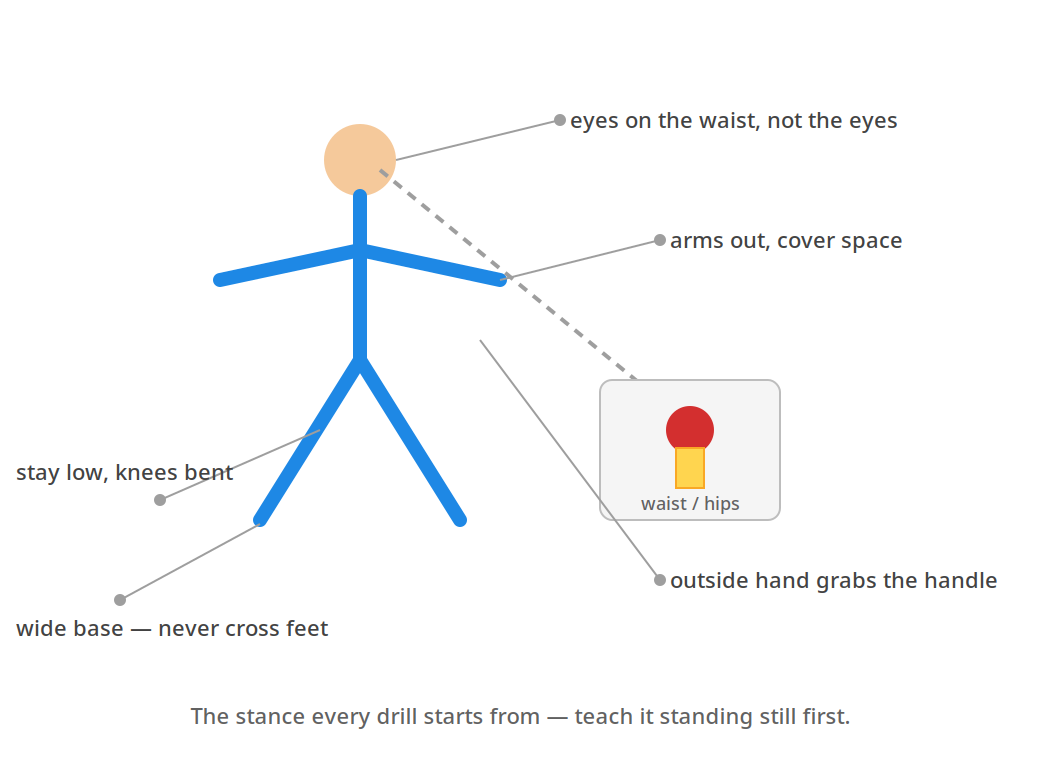
The 3 non-negotiables (teach these first)
Every drill below is just a delivery system for three technique points. Get these into your kids' heads before you run a single rep:
1. Shuffle, don't chase. Most beginners sprint straight at the ball carrier, reach out, and watch the runner cut past them. Defenders should shuffle side to side, short, choppy steps, always facing the runner, always in front of them. If your kid is running full speed at the ball carrier, the rep is already lost.
2. Stay low, break down, get big. Knees bent, wide stance, arms spread covering space. "Breaking down" means slowing down and getting balanced before the runner arrives — not during. And never cross your feet while shuffling. Crossed feet means one juke and you're on the ground.
3. Eyes on the waist, grab the handle. Watch the runner's hips and belly button, not their eyes, not their shoulders. Hips don't lie; eyes do. And when you reach, grab the handle at the very top of the flag belt with your outside hand — not the flag itself, not the shirt, not the shorts. Grab the handle and even if the flag doesn't come off clean, you're holding on to the runner.
Teach these three standing still first. Demo them yourself: badly, then well. Kids remember the funny-bad version and it loosens everyone up.
The 10 drills (easiest to hardest)
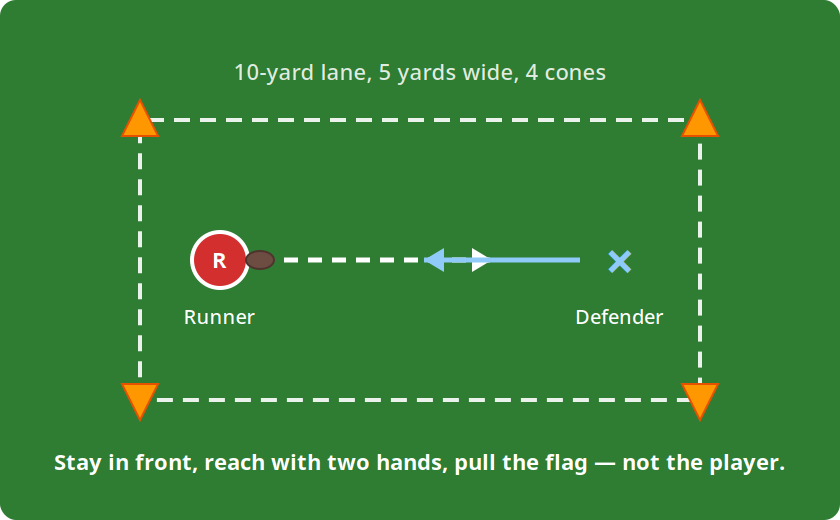
Drill 1: The Lane
Setup: Four cones making a lane about 10 yards long and 5 yards wide. Ball carrier at one end with the ball, defender at the other.
How to run it: On your whistle, the runner jogs straight down the lane, no juking yet. The defender closes, breaks down about two yards out, shuffles the last steps, and pulls the flag. Walk through it once at half speed, then run it for real. Two lines, constant rotation, no standing around.
The cue: "Stay in front of him."
Fix this: The defender sprints and dives at the flag. Slow the whole drill down and move the starting spots closer together. Reaching is a speed problem, not an effort problem. Get the breakdown right slow before you let them go fast.
Drill 2: Shuffle-Pull Zigzag
Setup: Eight cones in a zigzag across about 15 yards. A teammate wearing flags stands at each cone, flag turned inward and ready.
How to run it: The defender starts behind the first cone. On the whistle, they shuffle laterally to cone one, pull the flag with the outside hand, shuffle to cone two, all eight cones. Then flip the line around and run it back the other way so both sides get equal work. Have a parent or assistant re-attaching flags so the line never stops moving. Rep it over and over. This is a volume drill.
The cue: "Outside hand — grab the handle, not the flag."
Fix this: Kids grabbing low at the flag or coming back with a fistful of shirt. After every pull, make them hold up what they grabbed. If it's the handle, they did it right. They'll start policing themselves within about five minutes.
Bonus variation: the dollar-bill game: If your team is missing flags in games, duct-tape a dollar bill to every player's waist and run your flag-pulling drills grabbing for dollars. Kids who won't focus for a cone will sell out for a buck. (Yes, they keep the ones they pull. It's the best dollar you'll spend all season.)
Drill 3: Centipede 1-on-1
Setup: Five cones in a straight line, about 3 yards apart. Runner at one end, defender starting in the middle.
How to run it: The runner weaves through the cones, cut left, cut right, all the way down. The defender mirrors, breaks down at every cut, and tries to pull the flag before the runner clears the last cone. The constant cutting forces the defender to break down over and over, which is the whole point.
The cue: "Break down on every cut."
Fix this: The defender backpedals in a straight line instead of shuffling. Move the cones closer together until there's no room to backpedal, so they have no choice but to shuffle and stay square.
Drill 4: Sharks and Minnows
Setup: A 20-by-20-yard square. One shark in the middle. Everyone else is a minnow lined up on one sideline with flags on.
How to run it: On "go," the minnows try to cross to the far side without getting a flag pulled. Lose a flag, you become a shark. Last minnow standing wins, and becomes the first shark of the next round. Kids will beg to play this three times in a row. Let them, at least sometimes. They're getting hundreds of flag-pull reps while thinking it's just a game.
The cue: "Shuffle your feet, don't lunge."
Fix this: Sharks sprinting wildly past everyone. Shrink the square. Less space means the shark has to break down, use angles, and actually pull flags instead of just running fast.
Drill 5: Mirror Drill
Setup: Two cones a few yards apart. Partners face each other in the middle, both in breakdown stance.
How to run it: One kid is the leader, one is the mirror. The leader shuffles side to side between the cones; the mirror matches every step, staying low, staying square, never crossing feet. Fifteen seconds, then swap. Once they've got the footwork, add the finish: the leader tries to get past, and the mirror pulls the flag.
The cue: "Match his hips."
Fix this: The mirror crosses their feet and gets spun around. Slow the leader down. This drill only works if the mirror can stay square — speed up only when the feet stay clean.
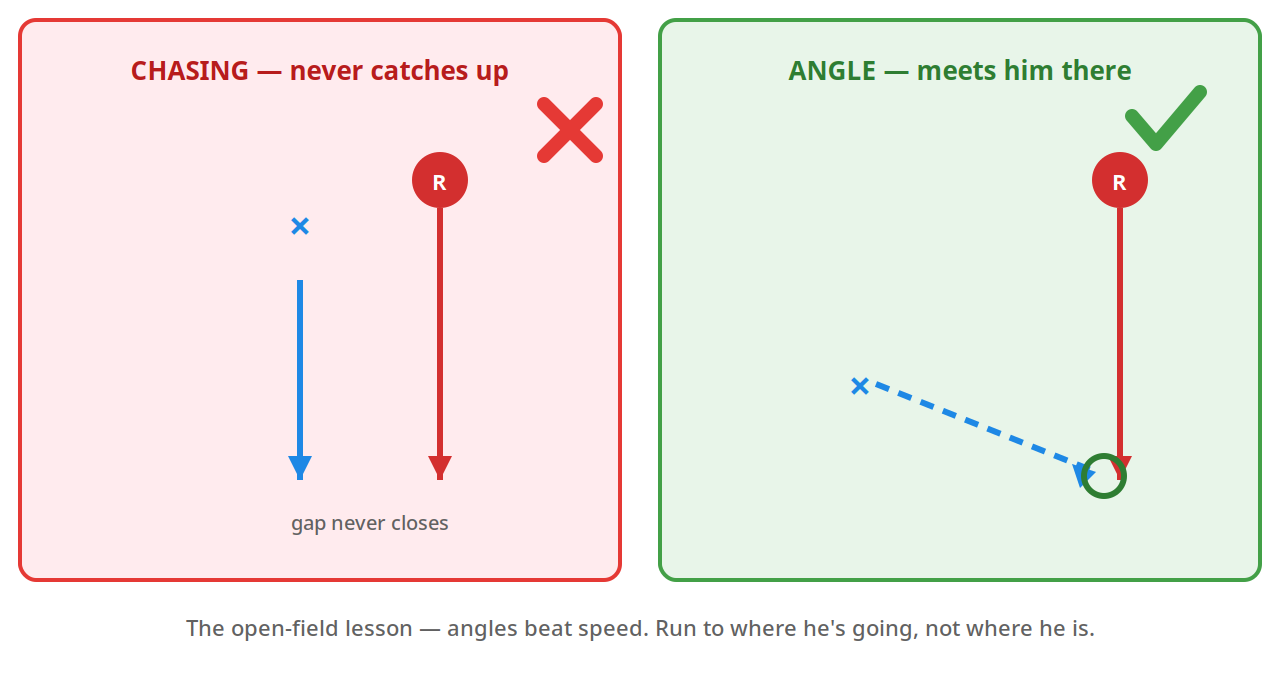
Drill 6: Angle Pursuit
Setup: Runner with the ball starts on one sideline. Defender starts in the middle of the field, about 10 yards behind the runner's line.
How to run it: On the whistle, the runner sprints up the sideline. The defender can't catch them by running straight at them. That's the lesson. They have to take a diagonal angle to the spot the runner is going to, meet them there, break down, and pull the flag. This is the open-field pull, and it's the hardest one in football.
The cue: "Run to where he's going, not where he is."
Fix this: Defenders chase directly behind the runner and never gain ground. Freeze the drill mid-run and ask the defender to point at where they'll meet the runner. Let them point, then run it again. Two freezes and they get it.
Drill 7: The Gauntlet
Setup: Two lines of defenders face each other a few yards apart, forming a corridor about 15 yards long. Runner with the ball at one end.
How to run it: The runner sprints through the corridor. Each defender gets one shot as the runner passes: break down, reach, pull. If someone gets the flag, re-belt at the end and keep going; the next defender steps up. Every kid gets to be the runner and every kid gets six or seven pull attempts in about two minutes.
The cue: "One shot — make it count."
Fix this: Defenders lunging into the corridor and colliding with each other. Make it a rule: feet stay in your box, arms do the work. You're teaching reach and timing, not tackling.
Drill 8: Turnover Circuit
Setup: You stand about 10 yards from a line of defenders and lob a soft "interception." A returner catches it; two chasers start a few yards behind the returner.
How to run it: The returner catches the pick and runs. The chasers have the two hardest jobs in flag football at once: take the right angle in the open field, then break down and finish the pull. Rotate everyone through all three spots.
The cue: "Slow feet, fast hands."
Fix this: Chasers sprinting full speed into the returner and whiffing. Teach the three-yard rule: at three yards out, slow the feet down and let the hands do the work. Fast feet past that point just mean a faster miss.
Drill 9: 2-on-1 Contain
Setup: Runner with the ball. Two defenders: one shaded toward the sideline, one inside.
How to run it: The runner tries to beat both. The sideline defender's only job is to turn the runner back inside. Never let them win the edge. The inside defender makes the pull. This teaches the two jobs of team defense: somebody contains, somebody finishes. Most youth defenses fail because everyone tries to do both.
The cue: "Sideline man turns him in. Inside man takes the flag."
Fix this: Both defenders chase the ball and the runner splits them. Freeze it and show the gap: "You were both on the same side. One of you owns the sideline — which one?" They'll sort it out themselves after that.
Drill 10: Live Scrimmage Constraints
Setup: Normal scrimmage, even squads.
How to run it: Don't just scrimmage. Scrimmage with one rule at a time. Week one: ball carrier has to stay between the hashes. Condensed field, way more pull attempts. Week two: every defender has to yell "ball!" before converging, builds the swarm habit so nobody quits on a play. Week three: full field, no constraints, and watch the technique show up in a real game.
The cue: "Same technique, faster game."
Fix this: Technique falls apart at full speed. That's normal. It means the habit isn't automatic yet. Drop back to a constraint for one series, then open it back up. The technique always comes back faster the second time.
How to fit them into practice
You don't need all ten. Here's the formula:
- Pick one or two per practice, 5–10 minutes each. That's it. Two drills done with full effort beat five done sloppily. Your drills block is only 15–20 minutes of a 60-minute practice: flag pulling owns half of it early in the season.
- First two weeks: drills 1 and 2 every single practice. The lane and the shuffle-pull zigzag are the foundation. Everything else is a variation once the technique is in their bodies.
- Then rotate. Add one new drill a week. By midseason your kids have the full toolbox and you only need one flag-pulling drill per practice to keep it sharp.
- Always finish with something live. End the flag-pulling block with sharks and minnows or a constrained scrimmage series. Technique sticks better when the last rep felt like a game.
Troubleshooting
"My kids reach instead of shuffling." Slow the drill down until the shuffle is right. Reaching is what happens when the feet can't keep up. It's a speed problem, not a laziness problem. Half speed with good feet beats full speed with bad feet every time.
"They keep grabbing shirts." Two fixes. First, the hold-it-up check from drill 2, make them show you the handle after every pull. Second, check your flag belts. Jerseys tucked in, belts snug around the waist, excess strap trimmed. Loose, floppy flags practically invite kids to grab cloth. Five minutes of belt fitting before practice saves twenty minutes of shirt-grabbing during it.
"They quit on the play." Give every kid a job after they're beaten. Teach the whole defense to yell "ball!" the moment the carrier crosses the line and swarm to the ball. A kid who got juked but sprints to join the swarm still made a play. Praise that loudly. Kids quit when they think the play is over for them. Make it never over until the whistle.
"One kid is scared." Usually it's not fear of contact. There's barely any contact in these drills. It's fear of looking silly in front of the team. Pair them with a patient partner, start at walking speed, and praise the first clean rep like they won a championship. Confidence is a skill too. It just takes a few more reps.
Start with the lane and the zigzag. Two weeks, every practice, ten minutes. Then come back and tell me your team can't pull flags. They'll be able to.
Your Next Step
Defense 101: Your First Defense →
These drills power this defense: here's the zone they make work.
Your First Practice: A Minute-by-Minute Script →
See exactly where the lane drill and the zigzag fit into your first hour.