


8U Practice Plan (Ages 7-8)
Seven and eight is the sweet spot. The chaos of 6U is fading, most kids can line up where you tell them, and a few even remember the play from last Tuesday. But they're still seven. Promise a scrimmage at the end and they'll run through a wall for you.
Bridge age: real fundamentals snuck into an hour that still feels like play. Get it right and your kids hit 10U knowing how to throw, catch, pull a flag, and run a route, ahead of most of the league.
The full plan: what makes 7-8 different, a minute-by-minute practice, the evaluation habit, what to hold off on, and the first four weeks.
What's different at 7-8
Three things change everything about how you run practice.
Attention spans stretch to 15–20 minutes. You can teach something, drill it, and move on without the wheels coming off. That's triple what you got at 5.
They remember last practice. This is the big one. At 6U you re-taught the snap every week. At 8U you can say "remember the shuffle pull from Tuesday?" and half of them actually do. Practices stack. Week 4 can assume week 2.
They can take a correction. Tell a 7-year-old "stay low when you shuffle" and watch them try it on the next rep. They're not just hearing you. They're adjusting.
This age lines up roughly with the "play and develop" stage of USA Football's youth model: kids work on the movement ABCs (agility, balance, coordination, speed) and get introduced to real football fundamentals through fun, noncontact practices and games. The model's rule for this stage is blunt: skill building, participation, and confidence matter more than the final score. Games and mini-competitions, not repetitive drills.
So teach real stuff, keep it moving, and don't run a two-hour drill circuit for eight-year-olds. They'll quit by week three and you'll deserve it.
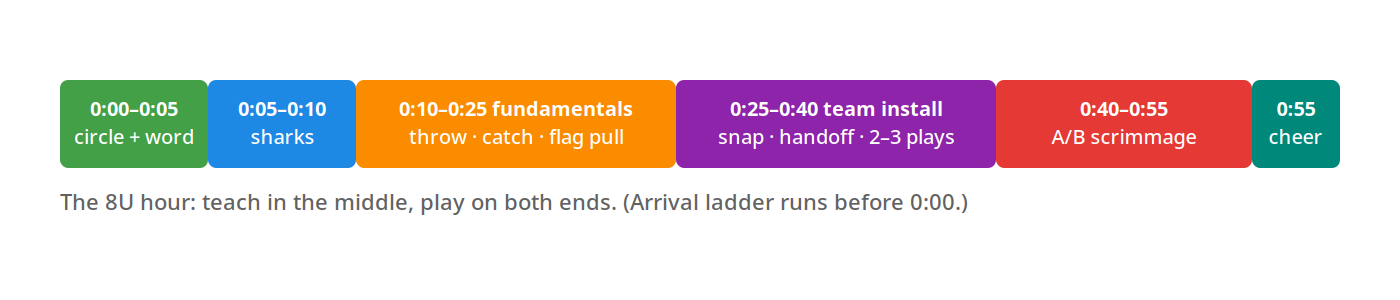
The 60-minute practice, minute by minute
Before 0:00 | Arrival: ladder and cuts (as kids show up)
Get there 15 minutes early with the field already set up, when kids walk up and see stations, they know a coach is in charge.
As kids arrive, send them 2–3 at a time through the agility ladder, then zigzag cone cuts. Whistle as each kid finishes, next one goes immediately. It burns off arrival energy, warms them up, and sets the pace: we're here to move.
0:00–0:05 | Circle up: warm-up + word of the day
"Bring it in! Circle up, take a knee."
Twenty jumping jacks, touch your toes, a few stretches. Keep it under four minutes. This is a warm-up, not a workout.
Then the word of the day: one word (effort, encouragement, sportsmanship, grit), sixty seconds on what it looks like out here. You'll revisit it at the end.
0:05–0:10 | Warm-up game: sharks and minnows
One shark in the middle, everyone else crosses without getting a flag pulled. Pulled minnows become sharks. Last minnow standing wins.
The kids think it's recess. You know it's secretly teaching them to run with their heads up, change direction, and pull flags at full speed.
0:10–0:25 | Fundamentals block (the teaching window)
This is your 15 minutes of real instruction, while attention is at its peak. Three five-minute stations, groups rotating, or teach the whole team at once. Either works, as long as nobody stands in line.
Throwing (5 min): The cue is point-step-throw: point the non-throwing hand at the target, step toward it, throw, follow through. Pair kids up close, then step back every few catches until they're throwing about 10 yards. Most arrive with a sidearm fling. "Good enough" for now: it comes out over the top and gets there.
Catching (5 min): Diamond hands, eyes on the ball all the way in. Throw it soft into the diamond. Hands go soft on contact. Drops are normal for weeks; don't make a thing of it.
Flag pulling (5 min): The most important skill in the sport, and the thing beginners are worst at. Teach it right and your defense transforms in a month.
The technique, taught the same way across youth coaches: don't chase — shuffle. Stay low, break down in front of the ball carrier (slow down, get balanced, get big), keep your eyes on their waist and hips (hips don't lie), and grab the handle at the very top of the flag belt with your outside hand. Not the flag itself, not the shirt. The handle. Even if you don't get the flag clean, you're holding on.
Run it as the shuffle pull: 8 cones in a zigzag, a flagged kid at each cone, the defender shuffling cone to cone, low, broken down, outside hand at every stop. Teach it 1-on-1 in a narrow lane first.
0:25–0:40 | Team install: the snap + 2–3 plays
The center-QB exchange (first 5 minutes, every practice for the first month): Teach a simple cadence: something like "ready… go." QB stands behind the center, head up, one hand out. Center snaps it clean, then (the part kids forget) runs a route instead of standing there admiring the snap. Pair everyone up with cones: five reps each, then switch. Clean snaps save you more practice time over a season than any drill on this list.
The handoff (5 minutes): The running back makes a basket with both hands (the "bread basket"), and the quarterback places the ball in it. Start at half speed, then full speed. Watch the QB's elbow: it stays under, not punching toward the RB's face.
Plays (5–10 minutes): Two or three plays from ONE formation, called in progressions: same formation, slightly different looks: a handoff one way, a fake and throw the other, a short pass, then a deep shot over the top. The defense thinks you're running the same play. You're not. Turn each play into a drill: rep the fake-and-go until it's boring, then twice more.
0:40–0:55 | Controlled scrimmage
A squad on offense, B squad on defense, the equal-skill groups from your evaluations. Switch at halftime. Freeze plays to fix alignment, praise the flag pull more than the touchdown. Not a game: practice that looks like a game.
0:55–1:00 | Cheer and recap
Bring it in. "Who showed effort today?" Two kids answer, then break on a cheer. End on a high note, every time. The kid who leaves happy comes back next week.
After practice: the parent text
Text the parents: what you worked on, one thing to practice at home, the word of the day. Two minutes. It turns parents into assistant coaches all week.
The evaluation habit: watch every practice, decide nothing
You're not picking positions at 8U. You're watching.
First practice, run the evaluation circuit. Four quick looks: a 20-yard sprint (who's fast?), receivers running routes (who has hands?), quarterbacks throwing (who has an arm?), a 1-on-1 cutting drill (who breaks down, who tries hard?). By the end of practice one, sort the roster into A and B squads of equal skill, not varsity and JV. Balanced squads make every scrimmage competitive.
Rotate everyone, all season. Nobody owns a position at eight. The FDM is explicit that young kids should play multiple positions, and the consistent coaching advice is to keep rotating through at least 4th or 5th grade. Put your most reliable hands at center, give every kid turns at the fun spots, and let games (not your day-one gut) sort out the rest.
One rule, stated early: you decide positions and who gets the ball. Not the kids, not the parents. Say it kindly, say it once ("I'll tell you where you're playing") and the lobbying stops. Otherwise you'll hear "I want quarterback" until November.
Keep evaluating. The kid who couldn't catch in week 1 might be your best receiver by week 5. Write any depth chart in pencil.
What NOT to do yet
Don't install more than a handful of plays. Three to five, from one or two formations, run in progressions. That's a full season of offense for 8U. If your players can't line up for play 3, you don't need a play 6. You need more reps of plays 1 through 3.
Don't lock anyone into a position. The fast kid is not "the running back" now and forever. He's the fast kid who also needs to learn to catch and pull flags, in two years the fast kid who can't catch is a liability.
Don't care about winning. USA Football's guidance for this stage is explicit: the experience beats the record. Your season is a success if every kid signs up again next year. A trophy at 8U is worth nothing if three kids quit.
Don't lecture. Demonstrate. Explanations fit inside 30 seconds. If you're still talking, you've lost them. When a kid says "just show me," listen.
Don't run lines. The moment more than three kids stand still watching one kid drill, you've got a design problem. Pairs, small groups, stations. Everyone moves, everyone reps.
The 4-week progression
Week 1: Names and baselines. Every kid's name. The evaluation circuit. The snap and the shuffle pull. End with sharks and minnows.
Week 2: Throwing, catching, first plays. Throwing progression and diamond catching. First two plays from one formation. First A/B scrimmage. It'll be messy — messy in week 2 is the price of clean in week 6.
Week 3: Routes and real defense. The go, the slant, the hitch. Shuffle pull again, because flag pulling needs weekly reps all season. Defense basics: break down and get big, eyes on the belly button, nobody gets behind you. Add play three.
Week 4: Put it together. Warm-up game, fundamentals, install review, scrimmage, in sequence. A/B squads set, three to five plays installed. By the end of week 4 your team lines up, runs a play, and pulls a flag. From here: reps, small adjustments, keep it fun.
That's the plan. An hour, a clipboard, a dozen cones, and the discipline to teach a little and play a lot. Do that for eight weeks and you'll be the coach parents request next season.
Your Next Step
Your First Practice: A Minute-by-Minute Script →
The first-practice script this plan builds on once the basics are in.
Defense 101: Your First Defense →
At 8U your controlled scrimmage needs a defense to line up against: start here.