


Defense 101: Man, Zone, and Where to Put Your Players
Your offense will figure itself out. Kids who can run and catch will score points almost by accident. Defense is where new coaches get exposed: ten kids standing around, everyone chasing the ball, one fast runner on the other team scoring four touchdowns while your players grab air.
Here's the good news: youth flag football defense is simple. There are really only two ways to play it, one formation family that covers almost everything, and three fundamentals that matter more than any scheme. This is the whole thing, in plain language.
First, the three fundamentals (scheme comes second)
No formation saves a defense that can't do these three things. Teach them before you teach anything else:
1. Break down and get big. When a defender gets near the ball carrier, they slow down, bend their knees, spread their arms wide, and shuffle side to side, never crossing their feet. They're a wall, not a missile. Kids who sprint straight at the runner get juked. Kids who break down make the runner choose a side, and that's when the flag gets pulled.
2. Eyes on the belly button. Not the eyes, not the shoulders, not the ball. Hips and belly buttons don't lie — wherever the belly button goes, the runner goes. A defender watching the runner's head will bite on every fake. A defender watching the belly button barely notices fakes at all.
3. Nobody gets behind you. This is the deep defender's entire job. The moment a receiver runs past your deepest player, it's a touchdown waiting to happen. Shuffle back, stay between the receiver and the end zone, and if you have to choose, give up the short catch every time. Short catches don't beat you. Deep ones do.
If your team does only these three things, you'll be a middle-of-the-pack defense with zero scheme at all. Everything below makes you better than that.
The big choice: man or zone?
Every defense you've ever seen is one of these two ideas, or a mix:
Man-to-man: each defender picks one offensive player and follows them wherever they go. Simple to explain ("you've got number 7"), and it works well when your athletes are as fast as theirs.
Zone: each defender owns an area of the field. If a receiver comes into your area, he's yours. If he leaves, you pass him off and protect your patch. Nobody chases anyone across the field.
For a first-year youth team, zone is the easier teach, and it's not close. Here's why:
- In man coverage, one kid who's slower than his matchup gives up touchdowns all game, and there's nothing he can do about it. In zone, speed mismatches mostly disappear. Your slower kids guard short areas, your faster kids guard deep ones.
- Man coverage falls apart the moment two receivers cross and your defenders run into each other. Zone defenders just stay home.
- Zone keeps your players facing the quarterback, which means they see the ball, and can swarm to it.
Man has its place: it's a good change-up late in a game, and some leagues' rules or your team's personnel might favor it. But if you're choosing one defense to install at your first practice, choose zone. Decide who covers whom before the huddle breaks if you ever do play man, say it out loud, every time, or two defenders will cover the same kid while another runs free.
The formation that covers almost everything (5v5)
Line up like this and you can handle most of what youth offenses do:
- 2 linebackers, about 3 yards off the line. These are your flag pullers. And here's the part new coaches get wrong: they should NOT be your fastest kids. They should be your best grabbers. The kid who always comes back holding a flag plays here, even if he's not quick. Their job: slow the run, take away the short dump-off passes, and be the wall the runner has to deal with first.
- 2 cornerbacks, behind the linebackers. They own the deep sides. If a receiver goes deep on their side, they turn and run with him, staying within a yard and never letting him behind. If the ball goes somewhere else, they turn in toward the play and swarm.
- 1 safety, about 10 yards deep in the middle. Your "monster." This IS the spot for your best athlete: the fastest kid with the best awareness, the one who reads the quarterback's eyes and doesn't bite on fakes. Nothing gets behind the safety. He cleans up everyone else's mistakes.
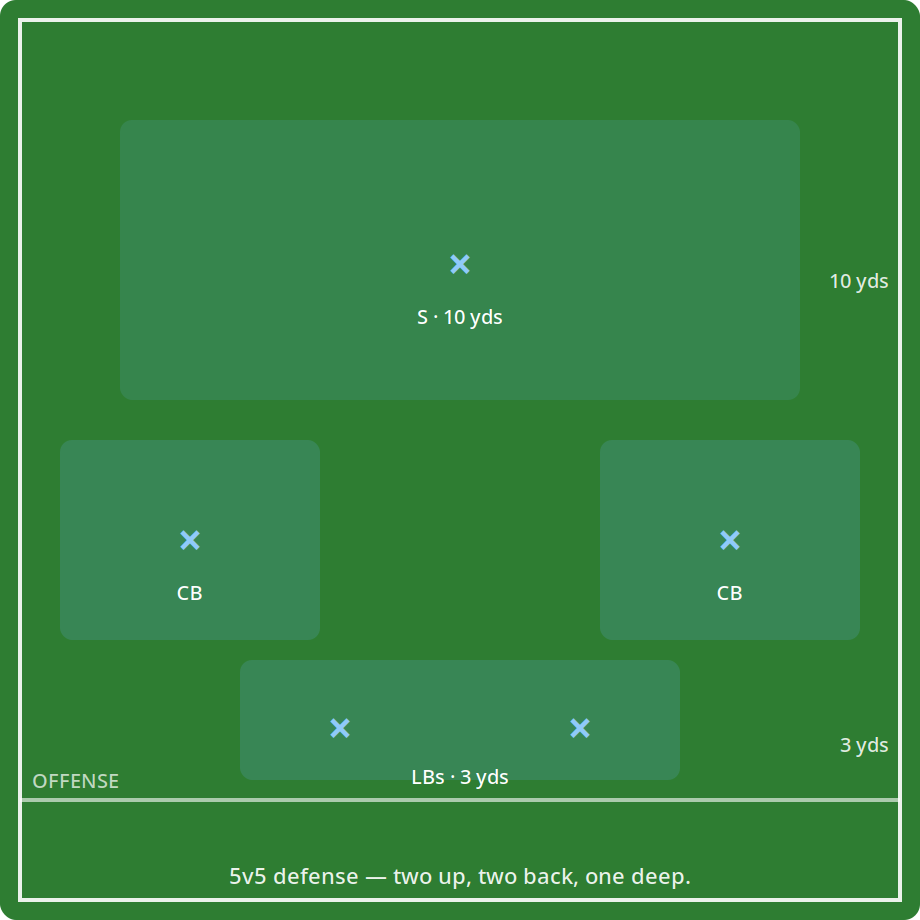
Playing 6v6? Add a middle linebacker a few yards deeper: someone agile who can drop back into coverage. Playing 7v7? Split it 2-3-2: two up front, three across the middle, two deep.
Adjusting: read the other team's offense
You don't need ten formations. You need this one, plus two tilts:
They run almost every play (common at ages 4–7): walk your cornerbacks up closer to the line. More bodies near the ball, fewer wasted deep. Think of it as a 3-2: three across the front, two behind.
They throw most of the time: drop to a 2-3: your two linebackers stay home for the short stuff, and three defenders (corners + safety, with the corners a step deeper) handle the passing game.
Watch the first three plays of the game. You'll know which team they are by then.
The blitz: one, and only one
Most youth leagues make a rusher start 7 yards off the line (check your rulebook; this varies). Blitzing feels aggressive and kids love it, but every blitzer leaves a hole where he was standing.
So: send one rusher, not two. Pick your spot (the best moment is when you expect a pass) and have the safety slide toward the side the rusher left. Use a code word or number so the offense doesn't know who's coming, and rotate who rushes so it stays unpredictable. Aim the rusher at the quarterback's throwing side, forcing him to roll toward his weak hand.
Against a running quarterback, skip the blitz entirely. A rusher charging in is just one less defender between the QB and the end zone when he takes off.
The swarm: how good defenses finish plays
Teach this at your first practice and praise it every time you see it: the moment the ball carrier crosses the line of scrimmage, the nearest defender yells "Ball! Ball! Ball!" and every defender runs to the play.
Two rules for the swarm:
- Run to where the runner is going, not where he is. Diagonal angles. The defender who chases straight at the ball carrier's heels never catches him.
- If your man doesn't have the ball, you're not done. Turn in, find the ball, join the swarm. Defenders who stand and watch their own receiver while a touchdown happens across the field are the #1 frustration of youth defense. Coach it out of them early.
The swarm is also your insurance policy. Your linebacker missed the flag? Fine. The cornerback who turned in and sprinted to the ball makes the pull five yards later. Defense played as a team forgives individual mistakes. Defense played as ten individuals doesn't.
Putting players where they win
Quick cheat sheet for your lineup card:
- Best flag pullers → linebacker. Hands over speed, every time.
- Fastest, smartest kid → safety. He sees the whole field and erases mistakes.
- Decent speed, good hands, coachable → cornerback. And coach the corners emotionally: every corner gets beaten sometimes. The ones who sulk give up two more touchdowns. Teach "next play" from day one.
- Struggles to find a role → linebacker, inside. "Get in the way" is a real job. A kid who gets big, slows the runner down, and yells "ball" so the swarm comes is contributing. Say so, out loud, where he can hear it.
Tell kids the truth about placement: "I'm putting you where you're strongest." Kids accept it when it's framed as trust, not demotion.
The one-sentence version
Break down and get big, watch the belly button, keep everyone in front of you, play zone with your best grabbers near the ball and your best athlete deep, and swarm when you hear "ball."
That's a real defense. Install it at one practice, rep it for ten minutes a week, and you'll stop watching the other team's fast kid score four times.
Your Next Step
Flag Pulling: The Skill That Wins Games →
Scheme only works if your players can pull flags. These drills build the breakdown, the shuffle, and the grab: the skills this defense runs on.
Flag Football Positions, Explained →
Who plays where in every format, and where to put first-timers so they succeed early.