


The Center–QB Exchange: Teach Clean Snaps and Kill the Fumbled Play
Every play starts with the snap. And in youth flag football, the snap is where plays go to die. The ball hits the ground, the quarterback chases it, the timing is gone, and nine other kids stand around watching.
Here's the encouraging part: the snap is not a talent. It's a routine. Two kids, one cadence, five minutes of paired reps at the start of practice, and by week three it just works, every time, and you never think about it again. This is the highest-return ten minutes in youth coaching.
Who should play center (it's not who you think)
Not your biggest kid. Not your worst athlete because "somebody has to do it."
Your most reliable hands. A bad snap kills the play before it starts; a clean one makes every play in your book work. Put the kid there who catches everything in warm-ups and does the same simple thing the same way every rep.
One thing that sells the job to kids: in flag football the center is an eligible receiver. He snaps the ball and then runs a route like everyone else. Nobody is stuck doing the boring job. The center touches the ball on every single play, then gets to go catch it.
Rotate early in the season so two or three kids can snap. You'll want a backup the day your starter is sick, and at 6U–8U everybody should try it anyway.
The exchange, step by step
Teach it exactly like this, in pairs, before you teach a single play.
The setup
- Center over the ball, feet about shoulder-width, head up. He needs to see the defense, not the ground.
- Quarterback in shotgun, about 4 yards behind the center. Skip under-center snaps until the shotgun exchange is automatic; shotgun gives a young QB time to catch the ball, look up, and think. Under-center is a fumble machine at this age.
- QB's hands: one hand out in front like a target. Head up, hand up. The center's whole job is to hit that target.
The cadence
Keep it to two words your whole team can hear: "Ready… GO!"
Same cadence, every play, every practice. Boring is the point. When the cadence never changes, the snap stops being a decision and becomes a reflex, and your receivers stop jumping early, because they know exactly when the ball is coming.
The snap
- The center snaps the ball back into the QB's waiting hand in one smooth motion: firm enough to arrive, soft enough to catch. Think "deliver it," not "throw it at him."
- The instant the ball leaves his hands, the center runs his route. This is the step kids forget. They snap, stand up, and admire it. Snap, then go. Say it until you don't have to.
- The QB catches, brings the ball up, and looks downfield. Head stays up through the whole exchange. A QB watching the ball arrive is a QB who sees the defense late.
Good enough looks like this: ten snaps in a row, same cadence, ball in the QB's hands clean every time, center off on his route without being reminded.
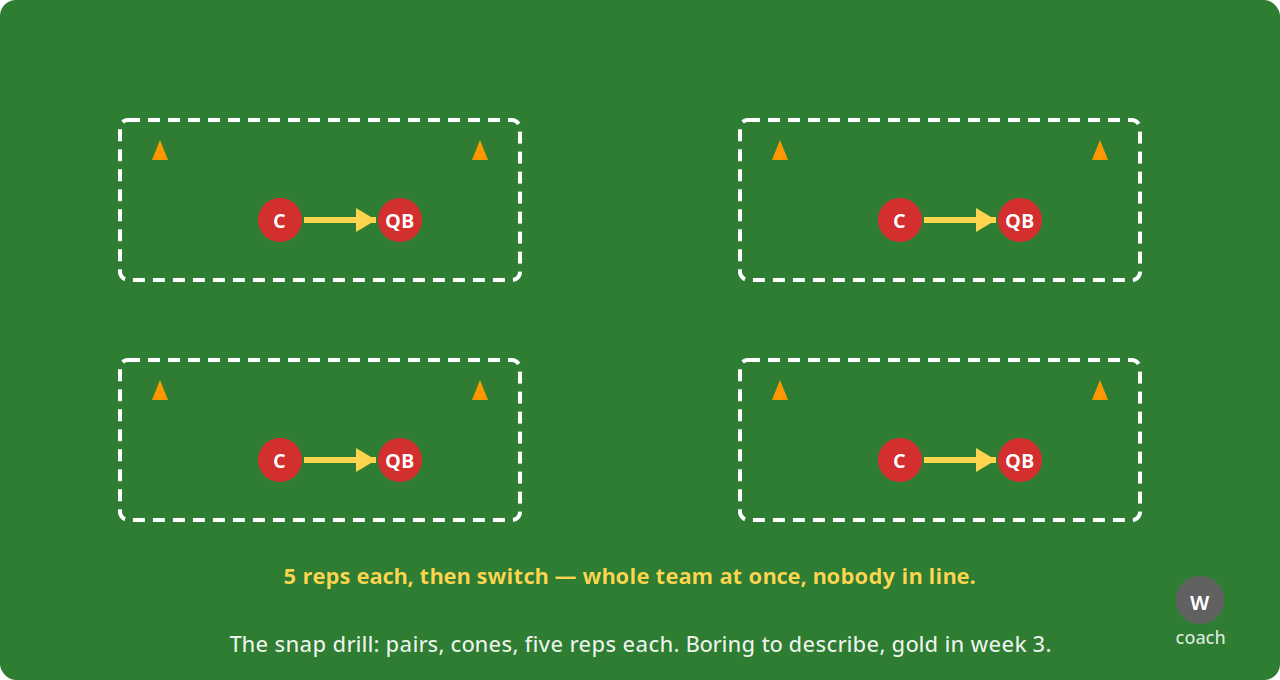
The pair drill (5 minutes, whole team at once)
This is how you teach it without a line of kids standing around:
- Pair everybody up. One center, one quarterback, a set of cones marking where to stand.
- Five reps each, then switch. Center snaps five on the cadence, then the pair swaps jobs. Everybody snaps, everybody catches.
- Run it at the start of practice: first five minutes of team install, every practice for the first month. Then taper to warm-ups.
That's it. No line, no waiting, the whole roster getting reps at once. Clean snaps will save you more practice time over a season than any drill in your plan. Every play you install afterward starts on time instead of starting with a scramble.
The 3 snap problems you'll see (and the one-line fix)
1. The ball on the ground. Usually the center is looking down or snapping too hard. Fix: "Head up, hit the target hand — deliver it, don't throw it."
2. The QB takes his eyes off the defense. He's watching the ball the whole way in because he doesn't trust the snap yet. Fix: more pair reps, not more talking. Trust is just reps that worked. Twenty clean snaps in practice and his eyes come up on their own.
3. The center who won't leave. Snaps perfectly, then stands at the line watching the play. Fix: give him the easiest route on the play (a short out or a hitch) and call his name in the huddle: "Snap it, then you're the first read." A center who might get the ball never forgets to run.
When the exchange breaks in a game
It will, once. A wet ball, a loud crowd, a new center. Your quarterback needs one rule: pick it up and run the play anyway. Or, if your league blows it dead, walk back, reset, same cadence. No blame, no huddle conference about whose fault it was. One bad snap is one play. Teams fall apart when one bad snap becomes three because everyone's still thinking about it.
Put the exchange in your warm-up before the game, ten snaps, and move on.
Teach this before your plays, before your routes, before anything fancy. A team that snaps it clean on every play looks coached — because it is. Everything else you install this season stands on these five minutes.
Your Next Step
How to Teach Kids to Throw a Football →
The snap is clean. Now give your quarterback a throwing motion worth snapping for.
Flag Football Positions, Explained →
Why the center is the most underrated job on the field, and who should play it.